Ambiguous Case for Triangle Side-Side-Angle Congruence
Theorem
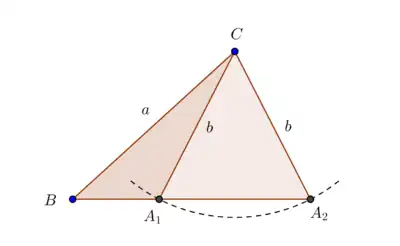
Let $\triangle ABC$ be a triangle.
Let the sides $a, b, c$ of $\triangle ABC$ be opposite $A, B, C$ respectively.
Let the sides $a$ and $b$ be known.
Let the angle $\angle B$ also be known.
Then it may not be possible to know the value of $\angle A$.
This is known as the .
Proof 1
From the Law of Sines, we have:
- $\dfrac {\sin a} {\sin A} = \dfrac {\sin b} {\sin B} = \dfrac {\sin c} {\sin C}$
from which:
- $\sin A = \dfrac {\sin a \sin B} {\sin b}$
We find that $0 < \sin A \le 1$.
We have that:
- $\sin A = \map \sin {\pi - A}$
and so unless $\sin A = 1$ and so $A = \dfrac \pi 2$, it is not possible to tell which of $A$ or $\pi - A$ provides the correct solution.
$\blacksquare$
Proof 2
Ambiguous Case for Triangle Side-Side-Angle Congruence/Proof 2
Also see
Sources
- 1976: W.M. Smart: Textbook on Spherical Astronomy (6th ed.) ... (previous) ... (next): Chapter $\text I$. Spherical Trigonometry: $6$. The sine-formula.
- 1998: David Nelson: The Penguin Dictionary of Mathematics (2nd ed.) ... (previous) ... (next): solution of triangles
- 2008: David Nelson: The Penguin Dictionary of Mathematics (4th ed.) ... (previous) ... (next): solution of triangles