Angle Bisector Theorem/Exterior Angle
Theorem
Let $\triangle ABC$ be a triangle.
Let $AB$ be produced past $A$ to $D$.
Let the external angle $CAD$ be bisected by $AE$ where $BE$ is $BC$ produced.
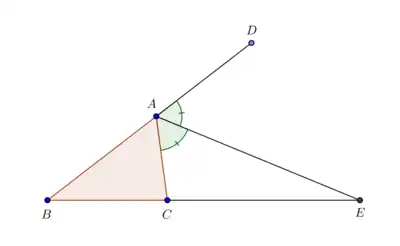
Then:
- $BE : EC = AB : AC$
Proof
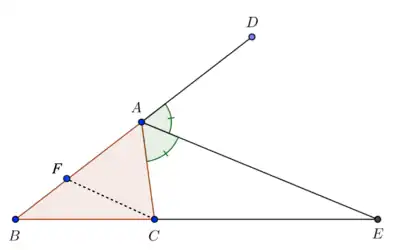
Construct $CF$ parallel to the angle bisector $AE$.
By Parallelism implies Equal Corresponding Angles:
- $\angle AFC = \angle DAE$
By Parallelism implies Equal Alternate Angles:
- $\angle ACF = \angle CAE$
Given that $\angle DAC$ is bisected:
- $\angle DAE = \angle CAE$
By Common Notion $1$:
- $\angle AFC = \angle ACF$
By Triangle with Two Equal Angles is Isosceles:
- $\triangle AFC$ is isosceles
By the definition of isosceles triangle:
- $AF = AC$
By Parallelism implies Equal Corresponding Angles:
- $\angle BAE = \angle BFC$
$\angle ABC$ is shared.
By Triangles with Two Equal Angles are Similar:
- $\triangle BFC \sim \triangle BAE$
By the definition of similar triangles:
- $AB : BE = AF : CE$
Substituting for $AF$:
- $AB : BE = AC : CE$
Rearrange to give:
- $AB : AC = BE : EC$
$\blacksquare$
Sources
- 2008: David Nelson: The Penguin Dictionary of Mathematics (4th ed.) ... (previous) ... (next): angle bisector theorem