Area of Circle/Proof 3
Theorem
The area $A$ of a circle is given by:
- $A = \pi r^2$
where $r$ is the radius of the circle.
Proof
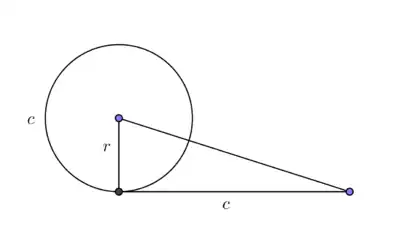
Construct a circle with radius $r$ and circumference $c$, whose area is denoted by $C$.
Construct a triangle with height $r$ and base $c$, whose area is denoted by $T$.
Lemma $1$
- $T = \pi r^2$
$\Box$
Lemma $2$
- $T \ge C$
$\Box$
Lemma $3$
- $T \le C$
$\Box$
Final Proof
From Lemma $2$:
- $T \ge C$
From Lemma $3$:
- $T \le C$
Therefore:
- $T \mathop = C$
and so from Lemma $1$:
- $C \mathop = T \mathop = \pi r^2$
$\blacksquare$
Historical Note
The was determined by Archimedes in his Measurement of a Circle.
Sources
- 1944: R.P. Gillespie: Integration (2nd ed.) ... (previous) ... (next): Chapter $\text I$: $\S 1$. Area of a Circle
- 1992: George F. Simmons: Calculus Gems ... (previous) ... (next): Chapter $\text {A}.5$: Archimedes (ca. $\text {287}$ – $\text {212}$ B.C.)
- 1998: David Nelson: The Penguin Dictionary of Mathematics (2nd ed.) ... (previous) ... (next): indirect proof
- 2008: David Nelson: The Penguin Dictionary of Mathematics (4th ed.) ... (previous) ... (next): indirect proof