Circle is Bisected by Diameter
Theorem
A circle is bisected by a diameter.
Proof 1
Let $AB$ be a diameter of a circle $ADBE$ whose center is at $C$.
By definition of diameter, $AB$ passes through $C$.
Aiming for a contradiction, suppose that $AB$ does not bisect $ADBE$, but that $ADBC$ is larger than $AEBC$.
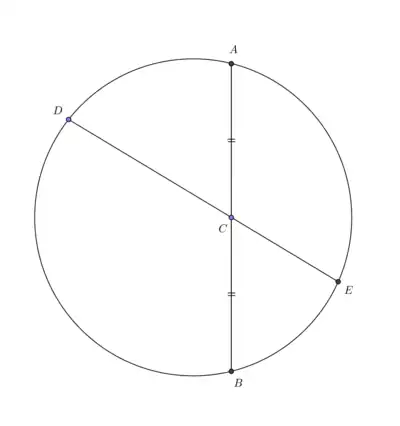
Thus it will be possible to find a diameter $DE$ passing through $C$ such that $DC \ne CE$.
Both $DC$ and $CE$ are radii of $ADBE$.
By Euclid's definition of the circle:
- A circle is a plane figure contained by one line such that all the straight lines falling upon it from one point among those lying within the figure are equal to one another;
- And the point is called the center of the circle.
That is, all radii of $ADBE$ are equal.
But $DC \ne CE$.
From this contradiction it follows that $AB$ bisects the circle.
$\blacksquare$
Proof 2
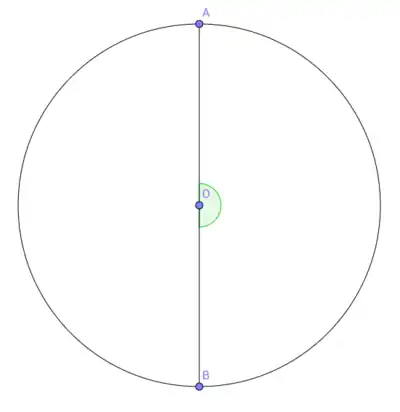
Let $AB$ be a diameter of a circle whose center is at $O$.
By definition of diameter, $AB$ passes through $O$.
$\angle AOB\cong\angle BOA$ because they are both straight angles.
Thus, the arcs are congruent by Equal Angles in Equal Circles:
- $\stackrel{\frown}{AB}\cong\stackrel{\frown}{BA}$
Hence, a circle is split into two equal arcs by a diameter.
$\blacksquare$
Historical Note
The result that a was supposedly attributed to Thales of Miletus by Proclus Lycaeus.
Euclid defines the diameter as the line which passes through the center, but then assumes that it necessarily bisects it:
- A diameter of the circle is any straight line drawn through the center and terminated in both directions by the circumference of the circle, and such a straight line also bisects the center.
According to Julian Lowell Coolidge in his A History of Geometrical Methods:
- It seems strange that Thales, a disciple of the Egyptians, should bother to demonstrate something which Euclid takes as self-evident. Proclus suggests that he proved it by folding the circle over the diameter.
Sources
- 1921: Sir Thomas Heath: A History of Greek Mathematics: Volume $\text { I }$ ... (previous) ... (next): $\text I$: Introductory: The Greeks and Mathematics