Complements of Parallelograms are Equal
Theorem
In the words of Euclid:
- In any parallelogram the complements of the parallelograms about the diameter are equal to one another.
(The Elements: Book $\text{I}$: Proposition $43$)
Proof
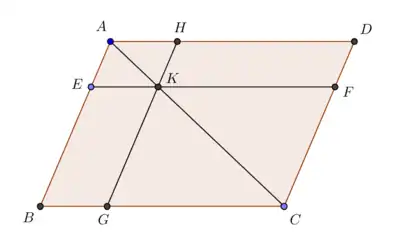
Let $ABCD$ be a parallelogram, and let $AC$ be a diameter.
Let $EKHA$ and $FKGC$ be parallelograms about $AC$.
Let $BEKG$ and $DFKH$ be the complements of $EKHA$ and $FKGC$.
From Opposite Sides and Angles of Parallelogram are Equal:
- $\triangle ABC = \triangle ACD$
Also from Opposite Sides and Angles of Parallelogram are Equal:
- $\triangle AEK = \triangle AHK$
- $\triangle KFC = \triangle KGC$
So from Common Notion 2:
- $\triangle AEK + \triangle KGC = \triangle AHK + \triangle KFC$
But the whole of $\triangle ABC$ equals the whole of $\triangle ACD$.
So when $\triangle AEK + \triangle KGC$ and $\triangle AHK + \triangle KFC$ are subtracted from $\triangle ABC$ and $\triangle ACD$ respectively, the complement $BEKG$ which remains is equal in area to $DFKH$, from Common Notion 3.
$\blacksquare$
Historical Note
This proof is Proposition $43$ of Book $\text{I}$ of Euclid's The Elements.
Sources
- 1926: Sir Thomas L. Heath: Euclid: The Thirteen Books of The Elements: Volume 1 (2nd ed.) ... (previous) ... (next): Book $\text{I}$. Propositions