Construction of Equal Straight Lines from Unequal
Theorem
Given two unequal straight line segments, it is possible to cut off from the greater a straight line segment equal to the lesser.
In the words of Euclid:
- Given two unequal straight lines, to cut off from the greater straight line a straight line equal to the less.
(The Elements: Book $\text{I}$: Proposition $3$)
Construction
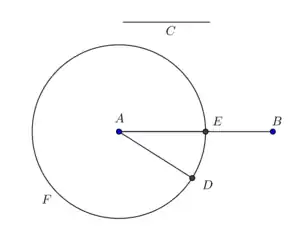
Let $AB$ and $C$ be the given straight line segments.
Let $AB$ be the greater of them.
At point $A$, we place $AD$ equal to $C$.
We construct a circle $DEF$ with center $A$ and radius $AD$.
The straight line segment $AE$ is the required line.
Proof
As $A$ is the center of circle $DEF$, it follows from Book $\text{I}$ Definition $15$: Circle that $AE = AD$.
But $C$ is also equal to $AD$.
So, as $C = AD$ and $AD = AE$, it follows from Common Notion 1 that $AE = C$.
Therefore, given the two straight line segments $AB$ and $C$, from the greater of these $AB$, a length $AE$ has been cut off equal to the lesser $C$.
$\blacksquare$
Historical Note
This proof is Proposition $3$ of Book $\text{I}$ of Euclid's The Elements.
Sources
- 1926: Sir Thomas L. Heath: Euclid: The Thirteen Books of The Elements: Volume 1 (2nd ed.) ... (previous) ... (next): Book $\text{I}$. Propositions