Construction of Golden Section
Theorem
In the words of Euclid:
- To cut a given finite straight line in extreme and mean ratio.
(The Elements: Book $\text{VI}$: Proposition $30$)
Construction
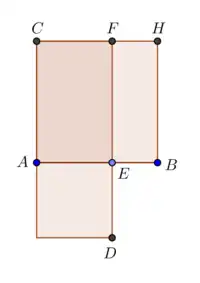
Let $AB$ be the given finite straight line.
Construct the square $\Box BC$ on $AB$.
Using Construction of Parallelogram Equal to Given Figure Exceeding a Parallelogram, construct $\Box CD$ equal to $\Box BC$ and exceeding by the figure $\Box AD$ similar to $\Box BC$.
Then $E$ is the point at which $AB$ is cut so that $AB : AE = AE : EB$.
Proof
As $\Box BC$ is a square, then $\Box AD$ is also a square.
Since $\Box CD = \Box BC$, we subtract $\Box CE$ from each.
Therefore $\Box BF = \Box AD$.
From Sides of Equal and Equiangular Parallelograms are Reciprocally Proportional, in $\Box BF$ and $\Box AD$ the sides about the equal angles are reciprocally proportional.
Therefore $FE : ED = AE : EB$.
But $FE = AB$ and $ED = AE$.
So $BA : AE = AE : EB$.
Also $AB > AE$ and so $AE > EB$.
Hence the result.
$\blacksquare$
Historical Note
This proof is Proposition $30$ of Book $\text{VI}$ of Euclid's The Elements.
Sources
- 1926: Sir Thomas L. Heath: Euclid: The Thirteen Books of The Elements: Volume 2 (2nd ed.) ... (previous) ... (next): Book $\text{VI}$. Propositions
- 1998: David Nelson: The Penguin Dictionary of Mathematics (2nd ed.) ... (previous) ... (next): golden section
- 2008: David Nelson: The Penguin Dictionary of Mathematics (4th ed.) ... (previous) ... (next): golden section