Construction of Regular Heptadecagon
Theorem
It is possible to construct a regular hepadecagon (that is, a regular polygon with $17$ sides) using a compass and straightedge construction.
Construction
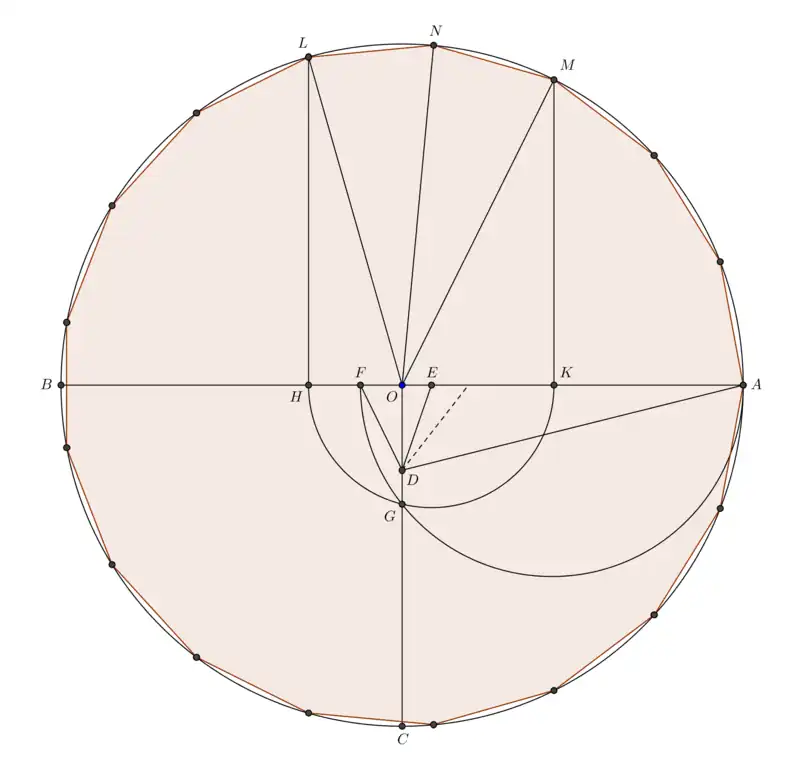
The construction will inscribe a regular hepadecagon inside any arbitrary circle.
By Euclid's Third Postulate:
- construct a circle with center $O$ and radius $OA$.
By Euclid's Second Postulate:
- produce $OA$ to $B$, hence making $AB$ a diameter of this circle.
By Proposition $11$ of Book $\text{I} $: Construction of Perpendicular Line:
- construct $OC$ perpendicular to $OA$.
By Proposition $10$ of Book $\text{I} $: Bisection of Straight Line twice:
- construct $OD$ whose length is $\dfrac 1 4$ the length of $OC$.
By Euclid's First Postulate:
- join $DA$.
By Proposition $9$ of Book $\text{I} $: Bisection of Angle twice:
- construct $\angle ODE$ to be $\dfrac 1 4$ the angle $\angle ODA$.
By Proposition $11$ of Book $\text{I} $: Construction of Perpendicular Line and Proposition $9$ of Book $\text{I} $: Bisection of Angle:
- construct $\angle EDF$ to be half a right angle.
Using Proposition $10$ of Book $\text{I} $: Bisection of Straight Line and Euclid's Third Postulate:
- construct a semicircle on $AF$ intersecting $OC$ at $G$.
By Euclid's Third Postulate:
- construct a semicircle with center $E$ and radius $EG$, intersecting $AB$ at $H$ and $K$.
By Proposition $11$ of Book $\text{I} $: Construction of Perpendicular Line:
- construct $HL$ and $KM$ perpendicular to $OA$, intersecting the circle $ACB$ at $L$ and $M$.
By Proposition $9$ of Book $\text{I} $: Bisection of Angle:
- bisect $\angle LOM$ to obtain angle $\angle NOM$.
By Euclid's First Postulate:
- join $NM$.
$NM$ is one of the sides of a regular hepadecagon which has been inscribed inside circle $ACB$.
Proof
It remains to be demonstrated that the line segment $NM$ is the side of a regular hepadecagon inscribed in circle $ACB$.
This will be done by demonstrating that $\angle NOM$ is equal to $\dfrac {2 \pi} {17}$ radians, that is, $\dfrac 1 {17}$ of the full circle $ACB$.
For convenience, let the radius $OA$ be equal to $4 a$.
By Pythagoras's Theorem, $AD = a \sqrt {17}$.
By definition of tangent, $OE = a \map \arctan {\dfrac {\angle ODA} 4}$.
By construction, $\angle EDF = \dfrac \pi 4$ radians.
Thus:
| \(\ds \frac {\tan \angle ODE + \tan \angle ODF} {1 - \tan \angle ODE \tan \angle ODF}\) | \(=\) | \(\ds \tan \angle EDF\) | Tangent of Sum | |||||||||||
| \(\ds \) | \(=\) | \(\ds 1\) | Tangent of $\dfrac \pi 4$ |
 | This needs considerable tedious hard slog to complete it. In particular: finish off -- the algebra gets complicated from here on in. To discuss this page in more detail, feel free to use the talk page. When this work has been completed, you may remove this instance of {{Finish}} from the code.If you would welcome a second opinion as to whether your work is correct, add a call to {{Proofread}} the page. |
Also see
Historical Note
The existence of the of the regular heptadecagon was first demonstrated by Carl Friedrich Gauss on $30$th March $1796$, at the age of $19$.
Some sources suggest that it was this discovery that led him to consider mathematics as a career option.
The construction given is the one given by Herbert William Richmond in $1893$.
Sources
- 1986: David Wells: Curious and Interesting Numbers ... (previous) ... (next): $17$
- 1997: David Wells: Curious and Interesting Numbers (2nd ed.) ... (previous) ... (next): $17$