Cycloid has Tautochrone Property
 | It has been suggested that this page or section be merged into Time of Travel down Brachistochrone/Corollary. To discuss this page in more detail, feel free to use the talk page. When this work has been completed, you may remove this instance of {{Mergeto}} from the code. |
Theorem
Let a wire $AB$ be curved into the shape of an arc of a cycloid such that:
- $A$ is at the cusp
- $B$ is the highest point of the arc
and inverted so that its cusps are uppermost and on the same horizontal line.
Thus $B$ is the lowest point of the arc.
Let $AB$ be embedded in a constant and uniform gravitational field where Acceleration Due to Gravity is $g$.
Let a bead $P$ be released from anywhere on the wire between $A$ and $B$ to slide down without friction to $B$.
Then the time taken for $P$ to slide to $B$ is:
- $T = \pi \sqrt {\dfrac a g}$
independently of the point from which $P$ is released.
That is, a cycloid is a tautochrone.
Proof
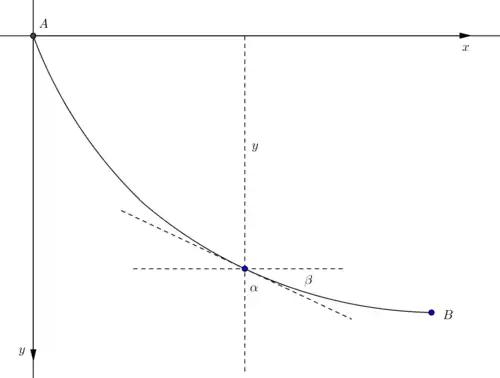
By the Principle of Conservation of Energy, the speed of the bead at a particular height is determined by its loss in potential energy in getting there.
Thus, at the point $\tuple {x, y}$, we have:
- $(1): \quad v = \dfrac {\d s} {\d t} = \sqrt {2 g y}$
This can be written:
| \(\ds \d t\) | \(=\) | \(\ds \frac {\d s} {\sqrt {2 g y} }\) | ||||||||||||
| \(\ds \) | \(=\) | \(\ds \frac {\sqrt {\d x^2 + \d y^2} } {\sqrt {2 g y} }\) |
Thus the time taken for the bead to slide down the wire is given by:
- $\ds T_1 = \int \sqrt {\dfrac {\d x^2 + \d y^2} {2 g y} }$
From Equation of Cycloid, we have:
- $x = a \paren {\theta - \sin \theta}$
- $y = a \paren {1 - \cos \theta}$
Substituting these in the above integral:
- $\ds T_1 = \int_0^{\theta_1} \sqrt {\dfrac {2 a^2 \paren {1 - \cos \theta} } {2 a g \paren {1 - \cos \theta} } } \rd \theta = \theta_1 \sqrt {\dfrac a g}$
This is the time needed for the bead to reach the bottom when released when $\theta_1 = \pi$, and so:
- $T_1 = \pi \sqrt {\dfrac a g}$
Now suppose the bead is released at any intermediate point $\tuple {x_0, y_0}$.
Take equation $(1)$ and replace it with:
- $v = \dfrac {\d s} {\d t} = \sqrt {2 g \paren {y - y_0} }$
Thus the total time to reach the bottom is:
| \(\ds T\) | \(=\) | \(\ds \int_{\theta_0}^\pi \sqrt {\dfrac {2 a^2 \paren {1 - \cos \theta} } {2 a g \paren {\cos \theta_0 - \cos \theta} } } \rd \theta\) | ||||||||||||
| \(\ds \) | \(=\) | \(\ds \sqrt {\dfrac a g} \int_{\theta_0}^\pi \sqrt {\dfrac {1 - \cos \theta} {\cos \theta_0 - \cos \theta} } \rd \theta\) | ||||||||||||
| \(\text {(2)}: \quad\) | \(\ds \) | \(=\) | \(\ds \sqrt {\dfrac a g} \int_{\theta_0}^\pi \dfrac {\sin \frac 1 2 \theta \rd \theta} {\sqrt {\cos^2 \frac 1 2 \theta_0 - \cos^2 \frac 1 2 \theta} } \rd \theta\) | Half Angle Formula for Cosine and Half Angle Formula for Sine |
Setting:
- $u = \dfrac {\cos \frac 1 2 \theta} {\cos \frac 1 2 \theta_0}$
and so:
- $\d u = -\dfrac 1 2 \dfrac {\sin \frac 1 2 \theta \rd \theta} {\cos \frac 1 2 \theta_0}$
Then $(2)$ becomes:
| \(\ds T\) | \(=\) | \(\ds -2 \sqrt {\dfrac a g} \int_1^0 \frac {\d u} {\sqrt {1 - u^2} }\) | ||||||||||||
| \(\ds \) | \(=\) | \(\ds 2 \sqrt {\dfrac a g} \Big [{\arcsin u}\Big]_0^1\) | ||||||||||||
| \(\ds \) | \(=\) | \(\ds \pi \sqrt {\dfrac a g}\) |
That is, wherever the bead is released from, it takes that same time to reach the bottom.
Hence the result.
$\blacksquare$
Also known as
The result can be seen referred to as the pendulum property of the cycloid.
Also see
- Brachistochrone is Cycloid, in which it is shown that a cycloid is also the shape for which the time is shortest.
Historical Note
The fact that was discovered by Christiaan Huygens in $1658$, during his work on developing a reliable and accurate pendulum clock.
The Tautochrone Problem was also solved independently by Niels Henrik Abel in $1823$, using the technique now known as Abel's integral equation.
Sources
- 1937: Eric Temple Bell: Men of Mathematics ... (previous) ... (next): Chapter $\text{V}$: "Greatness and Misery of Man"
- 1937: Eric Temple Bell: Men of Mathematics ... (previous) ... (next): Chapter $\text{VIII}$: Nature or Nurture?
- 1972: George F. Simmons: Differential Equations ... (previous) ... (next): $\S 2.11$: Problem $4$
- 1992: George F. Simmons: Calculus Gems ... (previous) ... (next): Chapter $\text {A}.17$: Huygens ($\text {1629}$ – $\text {1695}$)
- 1992: George F. Simmons: Calculus Gems ... (previous) ... (next): Chapter $\text {B}.21$: The Cycloid
- 1998: David Nelson: The Penguin Dictionary of Mathematics (2nd ed.) ... (previous) ... (next): cycloid
- 2008: David Nelson: The Penguin Dictionary of Mathematics (4th ed.) ... (previous) ... (next): cycloid