Densest Packing of Identical Circles
Theorem
The densest packing of identical circles in the plane obtains a density of $\dfrac \pi {2 \sqrt 3} = \dfrac \pi {\sqrt {12} }$:
- $\dfrac \pi {2 \sqrt 3} = 0 \cdotp 90689 \, 96821 \ldots$
This sequence is A093766 in the On-Line Encyclopedia of Integer Sequences (N. J. A. Sloane (Ed.), 2008).
This happens when they are packed together in a hexagonal array, with each circle touching $6$ others.
Proof
 | This theorem requires a proof. In particular: It remains to be proved that the hexagonal packing is in fact the densest that can be achieved. You can help $\mathsf{Pr} \infty \mathsf{fWiki}$ by crafting such a proof. To discuss this page in more detail, feel free to use the talk page. When this work has been completed, you may remove this instance of {{ProofWanted}} from the code.If you would welcome a second opinion as to whether your work is correct, add a call to {{Proofread}} the page. |
Consider the rectangular area $ABCD$ of the densest packing of circles.
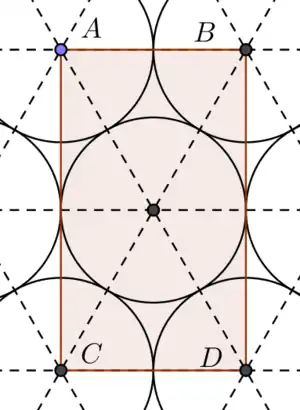
Let the radius of one circle be $1$.
The length $AB$ is $2$.
The length $AC$ is $2 \sqrt 3$.
Thus, from Area of Rectangle, the area of $\Box ABCD$ is $4 \sqrt 3$.
Within $ABCD$ there is one complete circle and one quarter of each of $4$ other circles.
That makes a total of $2$ circles.
Thus, from Area of Circle, the area of $ABCD$ which is inside a circle is $2 \pi$.
So the density is:
| \(\ds \dfrac {\text {Area of Circles} } {\text {Area of Rectangle} }\) | \(=\) | \(\ds \dfrac {2 \pi} {4 \sqrt 3}\) | ||||||||||||
| \(\ds \) | \(=\) | \(\ds \dfrac {\pi} {2 \sqrt 3}\) | ||||||||||||
| \(\ds \) | \(=\) | \(\ds \dfrac {\pi} {12}\) |
as required.
Sources
- 1983: François Le Lionnais and Jean Brette: Les Nombres Remarquables ... (previous) ... (next): $0,90689 9682 \ldots$
- 1986: David Wells: Curious and Interesting Numbers ... (previous) ... (next): $0 \cdotp 9068 \ldots$
- 1997: David Wells: Curious and Interesting Numbers (2nd ed.) ... (previous) ... (next): $0 \cdotp 9068 \ldots$