Derivative of Inverse Hyperbolic Cosecant
Theorem
Let $x \in \R_{\ne 0}$.
Let $\arcsch x$ denote the inverse hyperbolic cosecant of $x$.
Then:
- $\map {\dfrac \d {\d x} } {\arcsch x} = \dfrac {-1} {\size x \sqrt {1 + x^2} }$
Proof
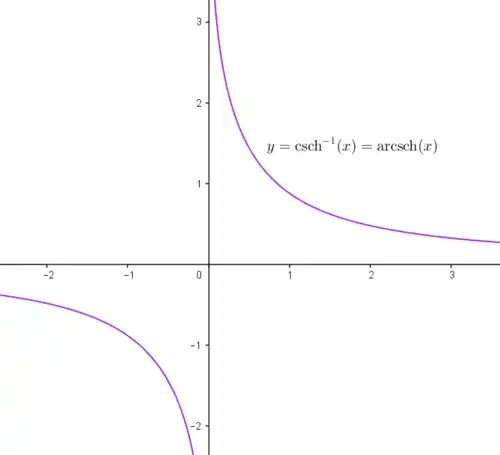
Let $x > 1$.
Then we have:
| \(\ds y\) | \(=\) | \(\ds \arcsch x\) | ||||||||||||
| \(\ds \leadsto \ \ \) | \(\ds x\) | \(=\) | \(\ds \csch y\) | where $y \ne 0$ | ||||||||||
| \(\ds \leadsto \ \ \) | \(\ds \frac {\d x} {\d y}\) | \(=\) | \(\ds -\csch y \coth y\) | Derivative of Hyperbolic Cosecant | ||||||||||
| \(\ds \leadsto \ \ \) | \(\ds \frac {\d y} {\d x}\) | \(=\) | \(\ds \dfrac {-1} {\csch y \coth y}\) | Derivative of Inverse Function | ||||||||||
| \(\ds \leadsto \ \ \) | \(\ds \frac {\d y} {\d x}\) | \(=\) | \(\ds \frac {-1} {\csch y \sqrt {1 + \csch^2 y} }\) | Difference of Squares of Hyperbolic Cotangent and Cosecant | ||||||||||
| \(\ds \leadsto \ \ \) | \(\ds \map {\frac \d {\d x} } {\arcsch x}\) | \(=\) | \(\ds \frac {-1} {x \sqrt {1 + x^2} }\) | Definition of $x$ and $y$ | ||||||||||
| \(\ds \) | \(=\) | \(\ds \frac {-1} {\size x \sqrt {1 + x^2} }\) | as $x > 0$ |
We have that Inverse Hyperbolic Cosecant is Odd Function.
Hence from Derivative of Odd Function is Even, $\map {\dfrac \d {\d x} } {\arcsch x}$ is even.
Hence for $x < -1$ we have that:
- $\map {\dfrac \d {\d x} } {\arcsch x} = \dfrac {-1} {\paren {-x} \sqrt {1 + x^2} }$
and so for $x < -1$:
- $\map {\dfrac \d {\d x} } {\arcsch x} = \dfrac {-1} {\size x \sqrt {1 + x^2} }$
and the result follows.
$\blacksquare$
Sources
- 1989: Ephraim J. Borowski and Jonathan M. Borwein: Dictionary of Mathematics ... (previous) ... (next): Appendix $2$: Table of derivatives and integrals of common functions: Inverse hyperbolic functions
- 1998: David Nelson: The Penguin Dictionary of Mathematics (2nd ed.) ... (previous) ... (next): Appendix: Table $1$: Derivatives
- 2008: David Nelson: The Penguin Dictionary of Mathematics (4th ed.) ... (previous) ... (next): Appendix: Table $1$: Derivatives