Dido's Problem/Variant 2
Problem
Consider the corner of a room which is separated from the rest of the room by a screen of two identical halves, $a$ and $b$ where the length of $a$ equals the length of $b$.
The screen meets the walls of the room at $A$ and $B$.
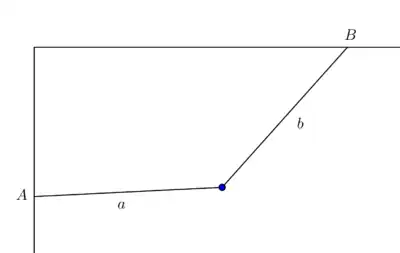
How can the screen be arranged so that the area enclosed by the screen is a maximum?
Solution
When the screen forms two sides of a regular octagon:
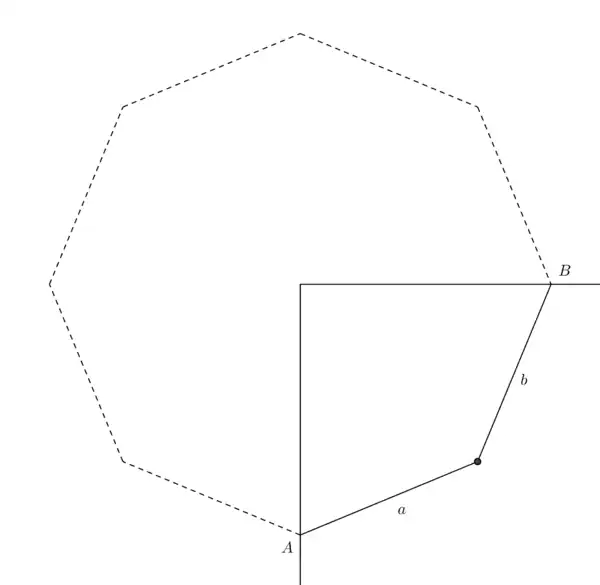
Thus the sides of the screen must make an angle of $67 \frac 1 2 \degrees$ with the walls.
Proof
When the area enclosed by the screen is a maximum, so will be the area of the octagon so formed by the construction above.
 | This needs considerable tedious hard slog to complete it. In particular: Invoke (and first create) the result about maximising the area of a polygon To discuss this page in more detail, feel free to use the talk page. When this work has been completed, you may remove this instance of {{Finish}} from the code.If you would welcome a second opinion as to whether your work is correct, add a call to {{Proofread}} the page. |
The angles the screen makes with the walls is half the internal angle of the regular octagon.
From Internal Angles of Regular Polygon, that is:
- $A = \dfrac 1 2 \paren {\dfrac {\paren {n - 2} 180 \degrees} n}$
where:
- $A$ is the angle the screen makes with the wall
- $n$ is the number of sides of the regular polygon, in this case $8$.
Hence the result.
$\blacksquare$
Sources
- 1992: David Wells: Curious and Interesting Puzzles ... (previous) ... (next): The Area Enclosed Against The Seashore: $32$