Equation of Astroid/Cartesian Form
Theorem
Let $H$ be the astroid generated by the epicycle $C_1$ of radius $b$ rolling without slipping around the inside of a deferent $C_2$ of radius $a = 4 b$.
Let $C_2$ be embedded in a cartesian plane with its center $O$ located at the origin.
Let $P$ be a point on the circumference of $C_1$.
Let $C_1$ be initially positioned so that $P$ is its point of tangency to $C_2$, located at point $A = \tuple {a, 0}$ on the $x$-axis.
Let $\tuple {x, y}$ be the coordinates of $P$ as it travels over the plane.
The point $P = \tuple {x, y}$ is described by the equation:
- $x^{2/3} + y^{2/3} = a^{2/3}$
Proof
By definition, an astroid is a hypocycloid with $4$ cusps.
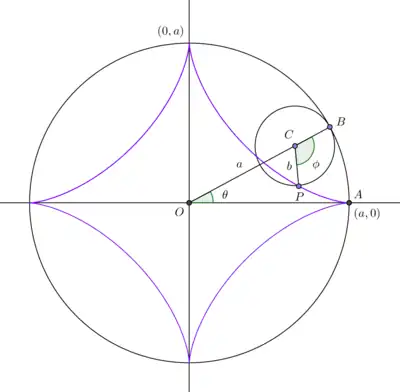
From the parametric form of the equation of an astroid, $H$ can be expressed as:
- $\begin{cases} x & = 4 b \cos^3 \theta = a \cos^3 \theta \\ y & = 4 b \sin^3 \theta = a \sin^3 \theta \end{cases}$
Squaring, taking cube roots and adding:
| \(\ds x^{2/3} + y^{2/3}\) | \(=\) | \(\ds a^{2/3} \paren {\cos^2 \theta + \sin^2 \theta}\) | ||||||||||||
| \(\ds \) | \(=\) | \(\ds a^{2/3}\) | Sum of Squares of Sine and Cosine |
$\blacksquare$
Sources
- 1968: Murray R. Spiegel: Mathematical Handbook of Formulas and Tables ... (previous) ... (next): $\S 11$: Special Plane Curves: Hypocycloid with Four Cusps: $11.8$
- 1989: Ephraim J. Borowski and Jonathan M. Borwein: Dictionary of Mathematics ... (previous) ... (next): hypocycloid
- 1992: George F. Simmons: Calculus Gems ... (previous) ... (next): Chapter $\text {B}.21$: The Cycloid
- 2008: David Nelson: The Penguin Dictionary of Mathematics (4th ed.) ... (previous) ... (next): astroid
- 2009: Murray R. Spiegel, Seymour Lipschutz and John Liu: Mathematical Handbook of Formulas and Tables (3rd ed.) ... (previous) ... (next): $\S 9$: Special Plane Curves: Hypocycloid with Four Cusps: $9.8.$