Equation of Epicycloid
Theorem
Let a circle $C_1$ of radius $b$ roll without slipping around the outside of a circle $C_2$ of radius $a$.
Let $C_2$ be embedded in a cartesian plane with its center $O$ located at the origin.
Let $P$ be a point on the circumference of $C_1$.
Let $C_1$ be initially positioned so that $P$ is its point of tangency to $C_2$, located at point $A = \tuple {a, 0}$ on the $x$-axis.
Let $H$ be the epicycloid traced out by the point $P$.
Let $\tuple {x, y}$ be the coordinates of $P$ as it travels over the plane.
The point $P = \tuple {x, y}$ is described by the equations:
| \(\ds x\) | \(=\) | \(\ds \paren {a + b} \cos \theta - b \map \cos {\paren {\dfrac {a + b} b} \theta}\) | ||||||||||||
| \(\ds y\) | \(=\) | \(\ds \paren {a + b} \sin \theta - b \map \sin {\paren {\dfrac {a + b} b} \theta}\) |
Proof
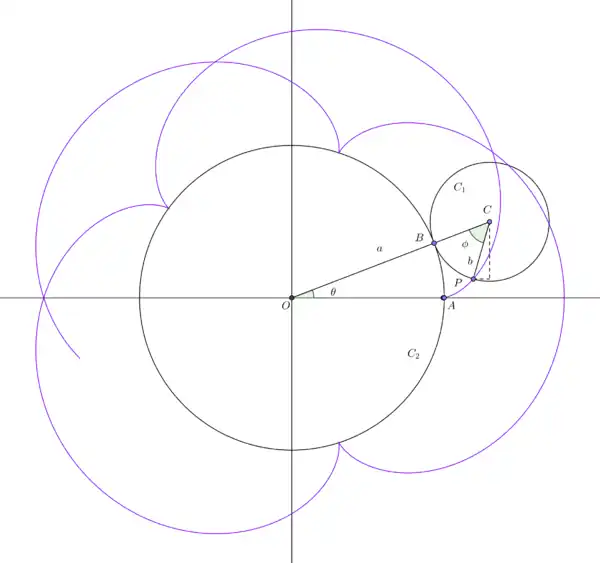
Let $C_1$ have rolled so that the line $OC$ through the radii of $C_1$ and $C_2$ is at angle $\theta$ to the $x$-axis.
Let $C_1$ have turned through an angle $\phi$ to reach that point.
By definition of sine and cosine, $P = \tuple {x, y}$ is defined by:
| \(\ds x\) | \(=\) | \(\ds \paren {a + b} \cos \theta - b \map \cos {\phi + \theta}\) | ||||||||||||
| \(\ds y\) | \(=\) | \(\ds \paren {a + b} \sin \theta - b \map \sin {\phi + \theta}\) |
The arc of $C_1$ between $P$ and $B$ is the same as the arc of $C_2$ between $A$ and $B$.
Thus by Arc Length of Sector:
- $a \theta = b \phi$
Thus:
- $\phi + \theta = \paren {\dfrac {a + b} b} \theta$
whence the result.
$\blacksquare$
Sources
- 1968: Murray R. Spiegel: Mathematical Handbook of Formulas and Tables ... (previous) ... (next): $\S 11$: Special Plane Curves: Epicycloid: $11.18$
- 1992: George F. Simmons: Calculus Gems ... (previous) ... (next): Chapter $\text {B}.21$: The Cycloid: Problem $12$
- 1998: David Nelson: The Penguin Dictionary of Mathematics (2nd ed.) ... (previous) ... (next): epicycloid
- 2008: David Nelson: The Penguin Dictionary of Mathematics (4th ed.) ... (previous) ... (next): epicycloid
- 2009: Murray R. Spiegel, Seymour Lipschutz and John Liu: Mathematical Handbook of Formulas and Tables (3rd ed.) ... (previous) ... (next): $\S 9$: Special Plane Curves: Epicycloid: $9.18.$