Exradius of Triangle in Terms of Circumradius
Theorem
Let $\triangle ABC$ be a triangle whose sides are $a$, $b$ and $c$ opposite vertices $A$, $B$ and $C$ respectively.
Let $\rho_a$ be the exradius of $\triangle ABC$ with respect to $a$.
Let $R$ be the circumradius of $\triangle ABC$.
Then:
- $\rho_a = 4 R \sin \dfrac A 2 \cos \dfrac B 2 \cos \dfrac C 2$
Proof 1
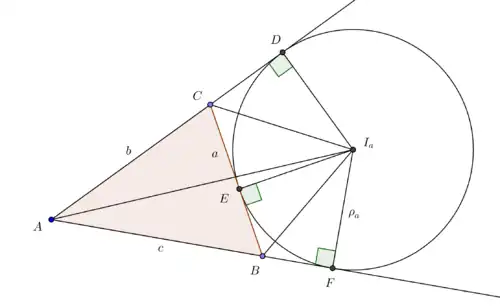
By construction:
| \(\ds AF\) | \(=\) | \(\ds AD\) | ||||||||||||
| \(\ds BF\) | \(=\) | \(\ds BE\) | ||||||||||||
| \(\ds CD\) | \(=\) | \(\ds CE\) | ||||||||||||
| \(\ds \leadsto \ \ \) | \(\ds AB + BE\) | \(=\) | \(\ds AC + CE\) | |||||||||||
| \(\ds \) | \(=\) | \(\ds s\) | where $s$ is the semiperimeter | |||||||||||
| \(\ds \leadsto \ \ \) | \(\ds BE\) | \(=\) | \(\ds s - c\) | |||||||||||
| \(\ds EC\) | \(=\) | \(\ds s - b\) |
We have:
| \(\text {(1)}: \quad\) | \(\ds \rho_a\) | \(=\) | \(\ds A I_a \sin \frac A 2\) | Definition of Sine of Angle using $\triangle A I_a F$ |
Then:
| \(\ds \dfrac {A I_a} {\sin \angle A B I_a}\) | \(=\) | \(\ds \dfrac c {\sin \angle A I_a B}\) | Law of Sines applied to $\triangle A B I_a$ | |||||||||||
| \(\ds \leadsto \ \ \) | \(\ds \dfrac {A I_a} {\map \sin {90 \degrees + \frac B 2} }\) | \(=\) | \(\ds \dfrac c {\map \sin {90 \degrees - \frac B 2 - \frac A 2} }\) | |||||||||||
| \(\ds \leadsto \ \ \) | \(\ds \dfrac {A I_a} {\cos \frac B 2}\) | \(=\) | \(\ds \dfrac c {\sin \frac C 2}\) | |||||||||||
| \(\ds \) | \(=\) | \(\ds \dfrac {2 R \sin C} {\sin \frac C 2}\) | ||||||||||||
| \(\ds \) | \(=\) | \(\ds \dfrac {2 R \cdot 2 \sin \frac C 2 \cos \frac C 2} {\sin \frac C 2}\) | Double Angle Formula for Sine | |||||||||||
| \(\ds \) | \(=\) | \(\ds 4 R \cos \frac C 2\) | simplifying | |||||||||||
| \(\ds \leadsto \ \ \) | \(\ds A I_a\) | \(=\) | \(\ds 4 R \cos \frac B 2 \cos \frac C 2\) | |||||||||||
| \(\ds \leadsto \ \ \) | \(\ds \rho_a\) | \(=\) | \(\ds 4 R \sin \frac A 2 \cos \frac B 2 \cos \frac C 2\) | from $(1)$ |
$\blacksquare$
Proof 2
Let $r$ denote the inradius of $\triangle ABC$.
We have:
| \(\ds r\) | \(=\) | \(\ds 4 R \sin \dfrac A 2 \sin \dfrac B 2 \sin \dfrac C 2\) | Inradius in Terms of Circumradius | |||||||||||
| \(\ds \leadsto \ \ \) | \(\ds \rho_a\) | \(=\) | \(\ds 4 R \sin \dfrac A 2 \map \sin {\dfrac {180 \degrees - B} 2} \map \sin {\dfrac {180 \degrees - C} 2}\) | |||||||||||
| \(\ds \) | \(=\) | \(\ds 4 R \sin \dfrac A 2 \map \sin {90 \degrees - \dfrac B 2} \map \sin {90 \degrees - \dfrac C 2}\) | ||||||||||||
| \(\ds \) | \(=\) | \(\ds 4 R \sin \dfrac A 2 \cos \dfrac B 2 \cos \dfrac C 2\) | Sine of Complement equals Cosine |
 | This article, or a section of it, needs explaining. In particular: Why the second line? From the book it says "It should be noted that this formula can be deduced from Inradius in Terms of Circumradius by writing $\paren {180 \degrees - B}$ for $B$ and $\paren {180 \degrees - C}$ for $C$" but plenty of work is needed to show why this is valid. You can help $\mathsf{Pr} \infty \mathsf{fWiki}$ by explaining it. To discuss this page in more detail, feel free to use the talk page. When this work has been completed, you may remove this instance of {{Explain}} from the code. |
$\blacksquare$
Sources
- 1953: L. Harwood Clarke: A Note Book in Pure Mathematics ... (previous) ... (next): $\text V$. Trigonometry: Formulae $(56)$