Hasse Diagram/Examples/Parallel Lines
Example of Hasse Diagram
Recall this partial ordering on the set of lines:
Let $S$ denote the set of all infinite straight lines embedded in a cartesian plane.
Let $\LL$ denote the relation on $S$ defined as:
- $a \mathrel \LL b$ if and only if:
- $a$ is parallel $b$
- if $a$ is not parallel to the $y$-axis, then coincides with or lies below $b$
- but if $b$ is parallel to the $y$-axis, then $a$ coincides with or lies to the right of $b$
Its dual $\LL^{-1}$ is defined as:
- $a \mathrel {\LL^{-1} } b$ if and only if:
- $a$ is parallel $b$
- if $a$ is not parallel to the $y$-axis, then coincides with or lies above $b$
- but if $b$ is parallel to the $y$-axis, then $a$ coincides with or lies to the left of $b$.
Then $\LL$ and $\LL^{-1}$ are partial orderings on $S$.
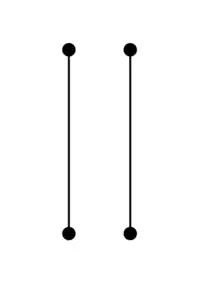
This Hasse diagram illustrates the restriction of $\LL$ to the set of all infinite straight lines in the cartesian plane which are parallel to and one unit away from either the $x$-axis or the $y$-axis.
Source of Name
This entry was named for Helmut Hasse.
Sources
- 1965: Seth Warner: Modern Algebra ... (previous) ... (next): Chapter $\text {III}$: The Natural Numbers: $\S 14$: Orderings: Figure $12 \ (3)$
- 1965: Seth Warner: Modern Algebra ... (previous) ... (next): Chapter $\text {III}$: The Natural Numbers: $\S 14$: Orderings: Exercise $14.1$