Inscribed Angle Theorem
Theorem
An inscribed angle is equal to half the angle that is subtended by that arc.
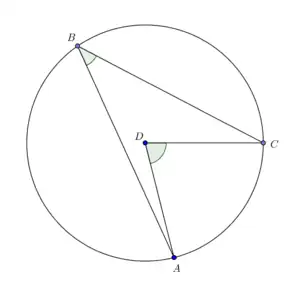
Thus, in the figure above:
- $\angle ABC = \frac 1 2 \angle ADC$
In the words of Euclid:
- In a circle the angle at the center is double of the angle at the circumference, when the angles have the same circumference as base.
(The Elements: Book $\text{III}$: Proposition $20$)
Proof 1
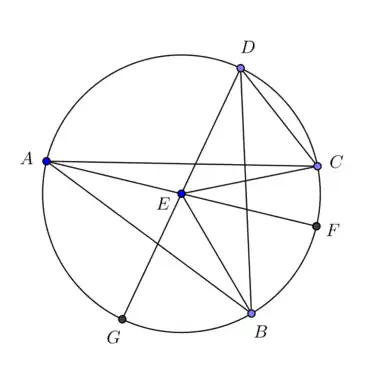
Let $ABC$ be a circle, let $\angle BEC$ be an angle at its center, and let $\angle BAC$ be an angle at the circumference.
Let these angles have the same arc $BC$ at their base.
Let $AE$ be joined and drawn through to $F$.
Since $EA = EB$, then from Isosceles Triangle has Two Equal Angles we have that $\angle EBA = \angle EAB$.
So $\angle EBA + \angle EAB = 2 \angle EAB$.
But from Sum of Angles of Triangle equals Two Right Angles we have that $\angle BEF = \angle EBA + \angle EAB$.
That is, $\angle BEF = 2 \angle EAB$.
For the same reason, $\angle FEC = 2 \angle EAC$.
So adding them together, we see that $\angle BEC = 2 \angle BAC$.
Now consider the point $D$, from which we have another angle $\angle BDC$.
Let $DE$ be joined and produced to $G$.
Similarly, we prove that $\angle GEC = 2 \angle EDC$.
Then $\angle GEB = 2 \angle EDB$.
Therefore $\angle BEC$ which remains is equal to $2 \angle BDC$.
Hence the result.
$\blacksquare$
Proof 2
Consider the simplest case that occurs when $AC$ is a diameter of the circle:
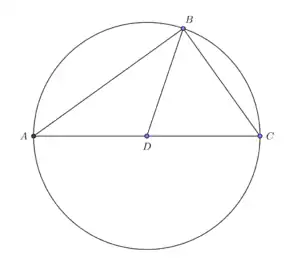
Because all lines radiating from $D$ to the circumference are radii and thus equal:
- $AD = BD = CD$
Hence the triangles $\triangle ADB$ and $\triangle BDC$ are isosceles.
Therefore from Isosceles Triangle has Two Equal Angles:
- $\angle DBC = \angle DCB$.
From Sum of Angles of Triangle equals Two Right Angles:
- $\angle BDC$ is a supplement of $\angle DBC + \angle DCB = 2 \angle DCB$.
From Thales' Theorem, $\angle ABC$ is right.
By similar reasoning $\angle DAB$ is the complement of $\angle DCB$.
If $\angle BDC$ is the supplement of twice the complement of $\angle DAB$, then $\angle BDC = 2 \angle DAB$.
That proves the theorem for this case.
$\Box$
The general case is illustrated below.
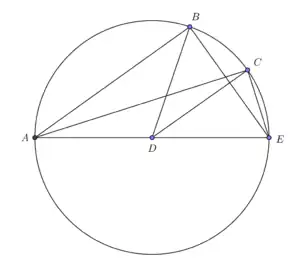
A diameter is drawn from $A$ through the center $D$ to $E$.
By the previous logic:
- $\angle BDE = 2 \angle BAE$
- $\angle CDE = 2 \angle CAE$
Subtracting the latter from the former equation obtains the general result.
$\blacksquare$
Sources
- 1998: David Nelson: The Penguin Dictionary of Mathematics (2nd ed.) ... (previous) ... (next): circle $(2)$
- 2008: David Nelson: The Penguin Dictionary of Mathematics (4th ed.) ... (previous) ... (next): circle $(2)$
- 2014: Christopher Clapham and James Nicholson: The Concise Oxford Dictionary of Mathematics (5th ed.) ... (previous) ... (next): circle theorems
- 2021: Richard Earl and James Nicholson: The Concise Oxford Dictionary of Mathematics (6th ed.) ... (previous) ... (next): circle theorems