Inscribing Circle in Triangle
Theorem
In the words of Euclid:
- In a given triangle to inscribe a circle.
(The Elements: Book $\text{IV}$: Proposition $4$)
Construction
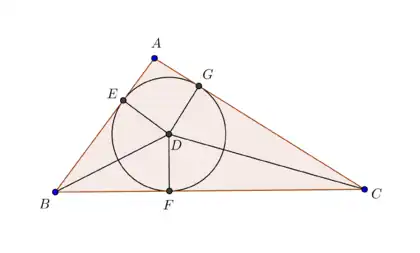
Let $\triangle ABC$ be the given triangle.
Let $\angle ABC$ and $\angle ACB$ be bisected by $BD$ and $CD$ and let these lines join at $D$.
From $D$ construct the perpendiculars $DE, DF, DG$ to $AB, BC, AC$ respectively.
Draw the circle with radius $DE$ and center $D$.
This is the required circle.
Proof
We have that $\angle ABD = \angle CBD$ and $\angle BED = \angle BFD$, a right angle, and $BD$ is common.
So from Triangle Angle-Side-Angle Congruence:
- $\triangle EBD = \triangle FBD$
So $DE = DF$.
For the same reason $DG = DF$.
So $DE = DF = DG$.
So the circle drawn with radius $DE$ will pass through $E, F$ and $G$.
From Line at Right Angles to Diameter of Circle it follows that $AB, AC, BC$ are tangent to the circle $EFG$.
Hence the result.
$\blacksquare$
Historical Note
This proof is Proposition $4$ of Book $\text{IV}$ of Euclid's The Elements.
Sources
- 1926: Sir Thomas L. Heath: Euclid: The Thirteen Books of The Elements: Volume 2 (2nd ed.) ... (previous) ... (next): Book $\text{IV}$. Propositions
- 1953: L. Harwood Clarke: A Note Book in Pure Mathematics ... (previous) ... (next): $\text {IV}$. Pure Geometry: Plane Geometry: The incentre
- 1998: David Nelson: The Penguin Dictionary of Mathematics (2nd ed.) ... (previous) ... (next): incentre
- 2008: David Nelson: The Penguin Dictionary of Mathematics (4th ed.) ... (previous) ... (next): incentre