Inscribing in Circle Triangle Equiangular with Given
Theorem
In the words of Euclid:
- In a given circle to inscribe a triangle equiangular with a given triangle.
(The Elements: Book $\text{IV}$: Proposition $2$)
Construction
Let $ABC$ be the given circle and let $\triangle DEF$ be the given triangle.
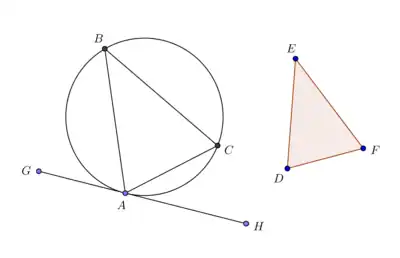
Let $GH$ be drawn tangent to $ABC$ at $A$.
On the straight line $AH$ construct $\angle HAC$ equal to $\angle DEF$.
On the straight line $AG$ construct $\angle GAB$ equal to $\angle DFE$.
Join $BC$.
Then $\triangle ABC$ is the given triangle.
Proof
We have that $AH$ touches the circle $ABC$, and $AC$ is a chord of circle $ABC$.
Then from the Tangent-Chord Theorem $\angle HAC = \angle ABC$.
But $\angle HAC = \angle DEF$.
Similarly, we have that $AG$ touches the circle $ABC$, and $AB$ is a chord of circle $ABC$.
Then from the Tangent-Chord Theorem $\angle GAB = \angle ACB$.
But $\angle GAB = \angle DFE$.
So from Sum of Angles of Triangle Equals Two Right Angles it follows that the remaining angles are equal also: $\angle BAC = \angle EDF$.
Hence the result.
$\blacksquare$
Historical Note
This proof is Proposition $2$ of Book $\text{IV}$ of Euclid's The Elements.
Sources
- 1926: Sir Thomas L. Heath: Euclid: The Thirteen Books of The Elements: Volume 2 (2nd ed.) ... (previous) ... (next): Book $\text{IV}$. Propositions
- 1992: George F. Simmons: Calculus Gems ... (previous) ... (next): Chapter $\text {A}.4$: Euclid (flourished ca. $300$ B.C.)