Kuratowski's Closure-Complement Problem
Theorem
Let $T = \struct {S, \tau}$ be a topological space.
Let $A \subseteq S$ be a subset of $T$.
By successive applications of the operations of complement relative to $S$ and the closure, there can be as many as $14$ distinct subsets of $S$ (including $A$ itself).
Example
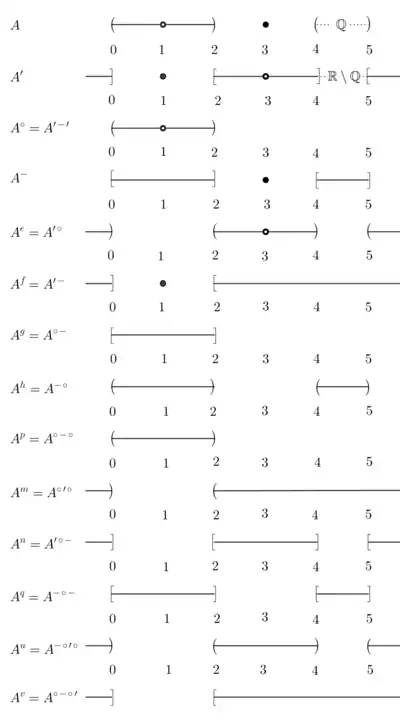
Let $\R$ be the real number line with the usual (Euclidean) topology.
Let $A \subseteq \R$ be defined as:
| \(\ds A\) | \(:=\) | \(\ds \openint 0 1 \cup \openint 1 2\) | Definition of Union of Adjacent Open Intervals | |||||||||||
| \(\ds \) | \(\) | \(\, \ds \cup \, \) | \(\ds \set 3\) | Definition of Singleton | ||||||||||
| \(\ds \) | \(\) | \(\, \ds \cup \, \) | \(\ds \paren {\Q \cap \openint 4 5}\) | Rational Numbers from $4$ to $5$ (not inclusive) |
Proof
That there can be as many as $14$ will be demonstrated by example.
Complement
The complement of $A$ in $\R$ is given by:
| \(\ds A'\) | \(=\) | \(\ds \hointl \gets 0\) | Definition of Unbounded Closed Real Interval | |||||||||||
| \(\ds \) | \(\) | \(\, \ds \cup \, \) | \(\ds \set 1\) | Definition of Singleton | ||||||||||
| \(\ds \) | \(\) | \(\, \ds \cup \, \) | \(\ds \hointr 2 3\) | Definition of Half-Open Real Interval | ||||||||||
| \(\ds \) | \(\) | \(\, \ds \cup \, \) | \(\ds \hointl 3 4\) | ... adjacent to Half-Open Real Interval | ||||||||||
| \(\ds \) | \(\) | \(\, \ds \cup \, \) | \(\ds \paren {\paren {\R \setminus \Q} \cap \closedint 4 5}\) | Irrational Numbers from $4$ to $5$ | ||||||||||
| \(\ds \) | \(\) | \(\, \ds \cup \, \) | \(\ds \hointr 5 \to\) | Definition of Unbounded Closed Real Interval |

Interior
The interior of $A$ in $\R$ is given by:
| \(\ds A^\circ\) | \(=\) | \(\ds \openint 0 1 \cup \openint 1 2\) | Union of Adjacent Open Intervals |

Closure
The closure of $A$ in $\R$ is given by:
| \(\ds A^-\) | \(=\) | \(\ds \closedint 0 2\) | Definition of Closed Real Interval | |||||||||||
| \(\ds \) | \(\) | \(\, \ds \cup \, \) | \(\ds \set 3\) | Definition of Singleton | ||||||||||
| \(\ds \) | \(\) | \(\, \ds \cup \, \) | \(\ds \closedint 4 5\) | Definition of Closed Real Interval |

Exterior
The exterior of $A$ in $\R$ is given by:
| \(\ds A^e\) | \(=\) | \(\ds \openint \gets 0\) | Definition of Unbounded Open Real Interval | |||||||||||
| \(\ds \) | \(\) | \(\, \ds \cup \, \) | \(\ds \openint 2 3 \cup \openint 3 4\) | Definition of Union of Adjacent Open Intervals | ||||||||||
| \(\ds \) | \(\) | \(\, \ds \cup \, \) | \(\ds \openint 5 \to\) | Definition of Unbounded Open Real Interval |

Closure of Complement
The closure of the complement of $A$ in $\R$ is given by:
| \(\ds A^{\prime \, -}\) | \(=\) | \(\ds \hointl \gets 0\) | Definition of Unbounded Closed Real Interval | |||||||||||
| \(\ds \) | \(\) | \(\, \ds \cup \, \) | \(\ds \set 1\) | Definition of Singleton | ||||||||||
| \(\ds \) | \(\) | \(\, \ds \cup \, \) | \(\ds \hointr 2 \to\) | Definition of Unbounded Closed Real Interval |

Closure of Interior
The closure of the interior of $A$ in $\R$ is given by:
| \(\ds A^{\circ \, -}\) | \(=\) | \(\ds \closedint 0 2\) | Definition of Closed Real Interval |

Interior of Closure
The interior of the closure of $A$ in $\R$ is given by:
| \(\ds A^{- \, \circ}\) | \(=\) | \(\ds \openint 0 2\) | Definition of Open Real Interval | |||||||||||
| \(\ds \) | \(\) | \(\, \ds \cup \, \) | \(\ds \openint 4 5\) | Definition of Open Real Interval |

Interior of Closure of Interior
The interior of the closure of the interior of $A$ in $\R$ is given by:
| \(\ds A^{\circ \, - \, \circ}\) | \(=\) | \(\ds \openint 0 2\) | Definition of Open Real Interval |

Interior of Complement of Interior
The interior of the complement of the interior of $A$ in $\R$ is given by:
| \(\ds A^{\circ \, \prime \, \circ}\) | \(=\) | \(\ds \openint \gets 0\) | Definition of Unbounded Open Real Interval | |||||||||||
| \(\ds \) | \(\) | \(\, \ds \cup \, \) | \(\ds \openint 2 \to\) | Definition of Unbounded Open Real Interval |

Closure of Interior of Complement
The closure of the interior of the complement of $A$ in $\R$ is given by:
| \(\ds A^{\prime \, \circ \, -}\) | \(=\) | \(\ds \hointl \gets 0\) | Definition of Unbounded Closed Real Interval | |||||||||||
| \(\ds \) | \(\) | \(\, \ds \cup \, \) | \(\ds \closedint 2 4\) | Definition of Closed Real Interval | ||||||||||
| \(\ds \) | \(\) | \(\, \ds \cup \, \) | \(\ds \hointr 5 \to\) | Definition of Unbounded Closed Real Interval |

Closure of Interior of Closure
The closure of the interior of the closure of $A$ in $\R$ is given by:
| \(\ds A^{- \, \circ \, -}\) | \(=\) | \(\ds \closedint 0 2\) | Definition of Closed Real Interval | |||||||||||
| \(\ds \) | \(\) | \(\, \ds \cup \, \) | \(\ds \closedint 4 5\) | Definition of Closed Real Interval |

Interior of Complement of Interior of Closure
The interior of the complement of the interior of the closure of $A$ in $\R$ is given by:
| \(\ds A^{- \, \circ \, \prime \, \circ}\) | \(=\) | \(\ds \left({\gets \,.\,.\, 0}\right)\) | Definition of Unbounded Open Real Interval | |||||||||||
| \(\ds \) | \(\) | \(\, \ds \cup \, \) | \(\ds \left({2 \,.\,.\, 4}\right)\) | Definition of Open Real Interval | ||||||||||
| \(\ds \) | \(\) | \(\, \ds \cup \, \) | \(\ds \left({5 \,.\,.\, \to}\right)\) | Definition of Unbounded Open Real Interval |

Complement of Interior of Closure of Interior
The complement of the interior of the closure of the interior of $A$ in $\R$ is given by:
| \(\ds A^{\circ \, - \, \circ \, \prime}\) | \(=\) | \(\ds \left({\gets \,.\,.\, 0}\right]\) | Definition of Unbounded Closed Real Interval | |||||||||||
| \(\ds \) | \(\) | \(\, \ds \cup \, \) | \(\ds \left[{2 \,.\,.\, \to}\right)\) | Definition of Unbounded Closed Real Interval |

Proof of Maximum
It remains to be shown that there can be no more than $14$.
Consider an arbitrary subset $A$ of a topological space $T = \struct {S, \tau}$.
To simplify the presentation:
- let $a$ be used to denote the operation of taking the complement of $A$ relative to $S$: $\map a A = S \setminus A$
- let $b$ be used to denote the operation of taking the closure of $A$ in $T$: $\map b A = A^-$
- let $I$ be used to denote the identity operation on $A$, that is: $\map I A = A$.
- let the parentheses and the reference to $A$ be removed, so as to present, for example:
- $\map a {\map b {\map a A} }$
- as:
- $a b a$
From Relative Complement of Relative Complement:
- $\map a {\map a A} = A$
or, using the compact notation defined above:
- $(1): \quad a a = I$
and from Closure of Topological Closure equals Closure:
- $\map b {\map b A} = \map b A = A^-$
or, using the compact notation defined above:
- $(2): \quad b b = b$
Let $s$ be a finite sequence of elements of $\set {a, b}$.
By successive applications of $(1)$ and $(2)$, it is possible to eliminate all multiple consecutive instances of $a$ and $b$ in $s$, and so reduce $s$ to one of the following forms:
- $\text{a)}: \quad a b a b \ldots a$
- $\text{b)}: \quad b a b a \ldots a$
- $\text{c)}: \quad a b a b \ldots b$
- $\text{d)}: \quad b a b a \ldots b$
From Closure of Complement of Closure is Regular Closed:
- $b a b$ is regular closed.
By Interior equals Complement of Closure of Complement, the interior of $A$ is:
- $a b a$
Recall the definition of regular closed:
- a set $A$ is regular closed if and only if it equals the closure of its interior.
And so as $b a b$ is regular closed:
- $b a b = b a b a \paren {b a b}$
So, adding an extra $b$ to either of $a b a b a b a$ or $b a b a b a$ will generate a string containing $b a b a b a b$ which can be reduced immediately to $b a b$.
It follows that the possible different subsets of $S$ that can be obtained from $A$ by applying $a$ and $b$ can be generated by none other than:
- $I$
- $a$
- $a b$
- $a b a$
- $a b a b$
- $a b a b a$
- $a b a b a b$
- $a b a b a b a$
- $b$
- $b a$
- $b a b$
- $b a b a$
- $b a b a b$
- $b a b a b a$
... a total of $14$.
Hence the result.
$\blacksquare$
Also known as
This result is also known as Kuratowski's Closure-Complement Theorem.
Source of Name
This entry was named for Kazimierz Kuratowski.
Sources
- 1922: Kazimierz Kuratowski: Sur l'operation A de l'Analysis Situs (Fundamenta Mathematicae Vol. 3: pp. 182 – 199)
- 1978: Lynn Arthur Steen and J. Arthur Seebach, Jr.: Counterexamples in Topology (2nd ed.) ... (previous) ... (next): Part $\text I$: Basic Definitions: Section $1$: General Introduction: Closures and Interiors
- 1978: Lynn Arthur Steen and J. Arthur Seebach, Jr.: Counterexamples in Topology (2nd ed.) ... (previous) ... (next): Part $\text {II}$: Counterexamples: $32$. Special Subsets of the Real Line: $9$