Length of Inradius of Triangle
Theorem
Let $\triangle ABC$ be a triangle whose sides are of lengths $a, b, c$.
Then the length of the inradius $r$ of $\triangle ABC$ is given by:
- $r = \dfrac {\sqrt {s \paren {s - a} \paren {s - b} \paren {s - c} } } s$
where $s = \dfrac {a + b + c} 2$ is the semiperimeter of $\triangle ABC$.
Proof
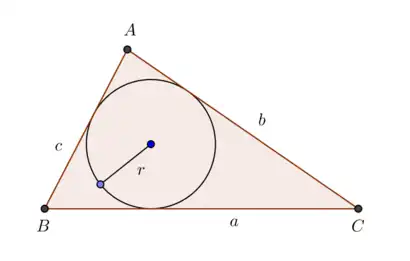
Let $\AA$ be the area of $\triangle ABC$.
From Area of Triangle in Terms of Inradius:
- $\AA = r s$
where $s = \dfrac {a + b + c} 2$ is the semiperimeter of $\triangle ABC$.
From Heron's Formula:
- $\AA = \sqrt {s \paren {s - a} \paren {s - b} \paren {s - c} }$
where $s = \dfrac {a + b + c} 2$ is the semiperimeter of $\triangle ABC$.
Hence the result:
- $r = \dfrac {\sqrt {s \paren {s - a} \paren {s - b} \paren {s - c} } } s$
$\blacksquare$
Sources
- 1968: Murray R. Spiegel: Mathematical Handbook of Formulas and Tables ... (previous) ... (next): $\S 4$: Geometric Formulas: Radius of Circle Inscribed in a Triangle of Sides $a, b, c$: $4.15$
- 2009: Murray R. Spiegel, Seymour Lipschutz and John Liu: Mathematical Handbook of Formulas and Tables (3rd ed.) ... (previous) ... (next): $\S 7$: Geometric Formulas: Radius of Circle Inscribed in a Triangle of Sides $a, b, c$: $7.15.$