Maximal Element need not be Unique/Examples
Examples of Maximal Element need not be Unique
Arbitrary Example $1$
Consider the set $S = \set {a, b, c, d, e}$ with the partial ordering $\preccurlyeq$ defined as:
- ${\preccurlyeq} := \set {\tuple {c, a}, \tuple {d, a}, \tuple {e, a}, \tuple {d, b}, \tuple {e, b}, \tuple {c, b}, \tuple {c, e} }$
This can be illustrated using the following Hasse diagram:
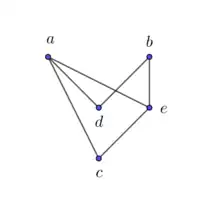
It can be seen by inspection that both $a$ and $b$ are maximal elements of the partially ordered set $\struct {S, \preccurlyeq}$.
Arbitrary Example $2$
Consider the set $S = \set {1, 3, 5, 7, 9}$ under the subset ordering.
Let $T \subseteq \powerset S$ be the set of subsets of $S$ that do not contain both $3$ and $5$.
Then the subsets $\set {1, 3, 7, 9}$ and $\set {1, 5, 7, 9}$ of $S$ are maximal elements of the partially ordered set $\struct {T, \subseteq}$.