Monotone Convergence Theorem (Real Analysis)
This proof is about Monotone Convergence Theorem in the context of Real Analysis. For other uses, see Monotone Convergence Theorem.
Theorem
Let $\sequence {x_n}$ be a bounded monotone sequence sequence in $\R$.
Then $\sequence {x_n}$ is convergent.
Increasing Sequence
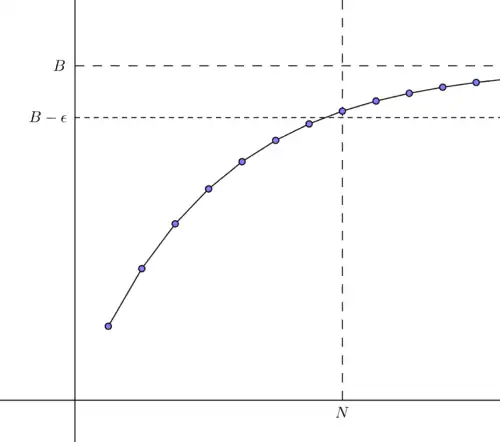
Let $\sequence {x_n}$ be an increasing real sequence which is bounded above.
Then $\sequence {x_n}$ converges to its supremum.
Decreasing Sequence
Let $\sequence {x_n}$ be a decreasing real sequence which is bounded below.
Then $\sequence {x_n}$ converges to its infimum.
Graphical Illustration
The following diagram illustrates the :
Examples
Example: $\dfrac {n - 1} n$
The sequence $\sequence {a_n}_{n \mathop \ge 1}$ defined as:
- $a_n = \dfrac {n - 1} n$
is convergent to the limit $1$.
Example: $x^n$ for $0 < x < 1$
Let $x \in \R$ such that $0 < x < 1$.
The sequence $\sequence {a_n}_{n \mathop \ge 1}$ defined as:
- $a_n = x^n$
is convergent to the limit $0$.
Sources
- 1953: Walter Rudin: Principles of Mathematical Analysis ... (previous): $3.14$
- 1975: W.A. Sutherland: Introduction to Metric and Topological Spaces ... (previous) ... (next): $1$: Review of some real analysis: $\S 1.2$: Real Sequences: Theorem $1.2.6$