Morley's Trisector Theorem
Theorem
Let $\triangle ABC$ be a triangle.
Let the internal angles of $\triangle ABC$ be trisected.
Let the points where these angle trisectors first intersect be $D$, $E$ and $F$.
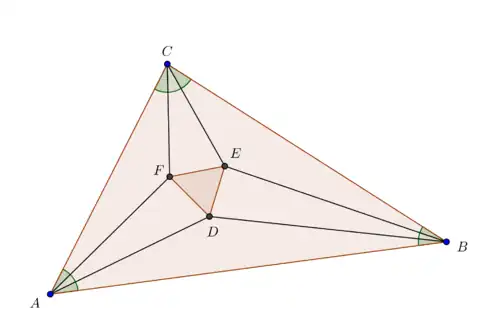
Then $\triangle EDF$ is equilateral.
Dijkstra's Proof
Choose angles $\alpha$, $\beta$ and $\gamma$ all greater than $0$ such that $\alpha + \beta + \gamma = 60 \degrees$.
Draw an equilateral triangle $\triangle XYZ$.
Construct $\triangle AXY$ and $\triangle BXZ$ with the angles as indicated:
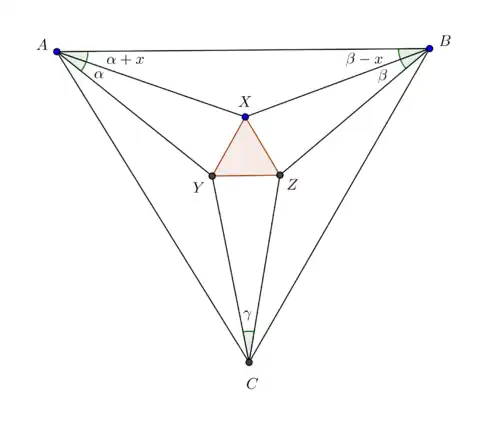
We have that:
| \(\ds \angle AXY\) | \(=\) | \(\ds 60 \degrees + \beta\) | ||||||||||||
| \(\ds \angle AYX\) | \(=\) | \(\ds 60 \degrees + \gamma\) | ||||||||||||
| \(\ds \angle BXZ\) | \(=\) | \(\ds 60 \degrees + \alpha\) | ||||||||||||
| \(\ds \angle BZX\) | \(=\) | \(\ds 60 \degrees + \gamma\) |
Because $\angle AXB = 180 \degrees - \paren {\alpha + \beta}$ , it follows that:
- if $\angle BAX = \alpha + x$ then $\angle ABX = \beta - x$
Using the Sine Rule $3$ times, in $\angle AXB$, $\angle AXY$ and $\angle BXZ$, we have:
| \(\ds \dfrac {\map \sin {\alpha + x} } {\map \sin {\beta - x} }\) | \(=\) | \(\ds \dfrac {BX} {AX}\) | ||||||||||||
| \(\ds \) | \(=\) | \(\ds \dfrac {XZ \map \sin {60 \degrees + \gamma} / \sin \beta} {XY \map \sin {60 \degrees + \gamma} / \sin \alpha}\) | ||||||||||||
| \(\ds \) | \(=\) | \(\ds \dfrac {\sin \alpha} {\sin \beta}\) |
In the range in which these angles lie, the left hand side of the above is a strictly increasing function of $x$.
Thus we conclude that $x = 0$.
The result follows.
$\blacksquare$
Proof 2
By comparing the given triangle $\triangle A'B'C'$ with the constructed triangle $\triangle ABC $, we shall prove that $\triangle X'Y'Z' \sim \triangle XYZ$ where $\triangle XYZ$ is an equilateral triangle.
The Given Triangle $\triangle A'B'C'$
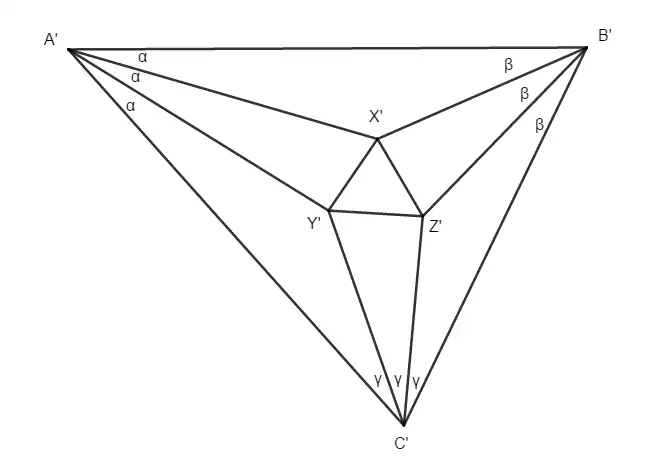
The Constructed Triangle $\triangle ABC$
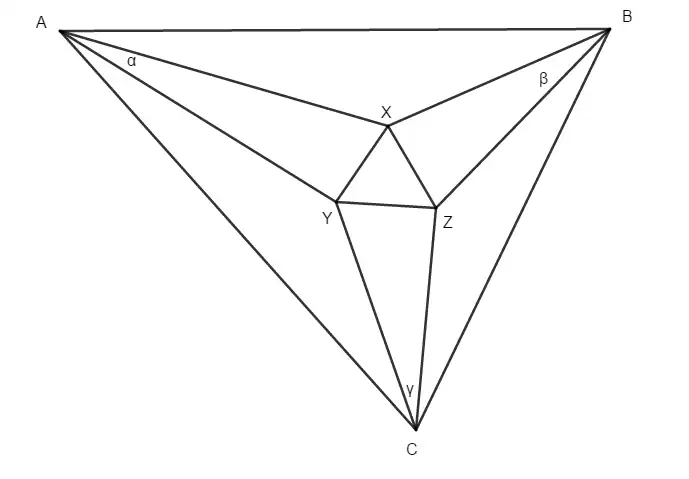
We begin by constructing $\triangle XYZ$, an equilateral triangle such that:
- $XY = YZ = XZ$
Noting that $\alpha + \beta + \gamma = 60 \degrees$, we construct $\triangle AXY$ such that:
| \(\ds \angle AXY\) | \(=\) | \(\ds 60 \degrees + \beta\) | ||||||||||||
| \(\ds \angle XZB\) | \(=\) | \(\ds 60 \degrees + \gamma\) |
| \(\ds \therefore \angle XAY\) | \(=\) | \(\ds 180 \degrees - (60 \degrees + \beta + 60 \degrees + \gamma)\) | ||||||||||||
| \(\ds \) | \(=\) | \(\ds 60 \degrees - \beta - 60 \degrees\) | ||||||||||||
| \(\ds \) | \(=\) | \(\ds \alpha\) |
Construct $\triangle BXZ$ such that:
| \(\ds \angle ZXB\) | \(=\) | \(\ds 60 \degrees + \alpha\) | ||||||||||||
| \(\ds \angle XZB\) | \(=\) | \(\ds 60 \degrees + \gamma\) | ||||||||||||
| \(\ds \therefore \angle XBZ\) | \(=\) | \(\ds \beta\) |
Construct $\triangle CYZ$ such that:
| \(\ds \angle BXZ\) | \(=\) | \(\ds 60 \degrees + \beta\) | ||||||||||||
| \(\ds \angle AYX\) | \(=\) | \(\ds 60 \degrees + \alpha\) | ||||||||||||
| \(\ds \therefore \angle YCZ\) | \(=\) | \(\ds \gamma\) |
Construct $AB$, $BC$ and $AC$, the sides of $\triangle ABC$.
$\angle AXB$ is calculated as follows:
| \(\ds \angle AXB\) | \(=\) | \(\ds 360 \degrees - ( \angle AXY +\angle YXZ + \angle BXZ )\) | ||||||||||||
| \(\ds \) | \(=\) | \(\ds 360 \degrees - ((60 \degrees + \beta) + 60 \degrees + (60 \degrees + \alpha))\) | ||||||||||||
| \(\ds \) | \(=\) | \(\ds 360 \degrees - (180 \degrees + \beta + \alpha)\) | ||||||||||||
| \(\ds \) | \(=\) | \(\ds 180 \degrees - \beta - \alpha\) |
To proceed, it is necessary to prove that $ \triangle A'X'B' \sim \triangle AXB$.
We shall provide two alternate proofs for this preposition; a trigonometric proof and a geometric proof.
Trigonometric proof for $\triangle A'X'B' \sim \triangle AXB$
Applying the Sine Rule for $\triangle XBZ$ and $\triangle XAY$, we have:
| \(\text {(1)}: \quad\) | \(\ds BX\) | \(=\) | \(\ds XZ \map \sin {\angle XZB} / \sin \beta = XZ \map \sin {60 \degrees + \gamma} / \sin \beta\) | |||||||||||
| \(\text {(2)}: \quad\) | \(\ds AX\) | \(=\) | \(\ds XY \map \sin {\angle AYX } / \sin \alpha = XY \map \sin {60 \degrees + \gamma } / \sin \alpha\) |
Dividing $(1)$ by $(2)$ and noting that by construction $XZ = XY$, we obtain:
| \(\text {(3)}: \quad\) | \(\ds \dfrac {BX } { AX}\) | \(=\) | \(\ds \dfrac {\sin \alpha} {\sin \beta}\) |
Applying the Sine Rule to $\triangle A'X'B' $, we get:
| \(\text {(4)}: \quad\) | \(\ds \dfrac {B'X' } { A'X'}\) | \(=\) | \(\ds \dfrac {\sin \alpha} {\sin \beta}\) |
Combining $(3)$ and $(4)$, yields:
| \(\ds \dfrac {BX } { AX}\) | \(=\) | \(\ds \dfrac {B'X'} {A'X'}\) |
For $\triangle A'X'B' $, we have:
| \(\ds \angle A'X'B'\) | \(=\) | \(\ds 180 \degrees - \beta - \alpha\) |
and we have already shown that:
| \(\ds \angle AXB\) | \(=\) | \(\ds 180 \degrees - \beta - \alpha\) | ||||||||||||
| \(\ds \leadsto \angle AXB\) | \(=\) | \(\ds \angle A'X'B'\) | ||||||||||||
| \(\ds \therefore \triangle A'X'B'\) | \(\sim\) | \(\ds \triangle AXB\) | Triangles with One Equal Angle and Two Sides Proportional are Similar |
Consequently, $\angle BAX = \alpha $ and $\angle ABX = \beta $.
In a similar fashion, we can obtain the following triangle similarities:
| \(\ds \triangle A'Y'C'\) | \(\sim\) | \(\ds \triangle CYC\) | ||||||||||||
| \(\ds \triangle B'Z'C'\) | \(\sim\) | \(\ds \triangle BZC\) |
--- End of the Trigonometric Proof for $\triangle A'X'B' \sim \triangle AXB$ ---
Geometric proof for $\triangle A'X'B' \sim \triangle AXB$
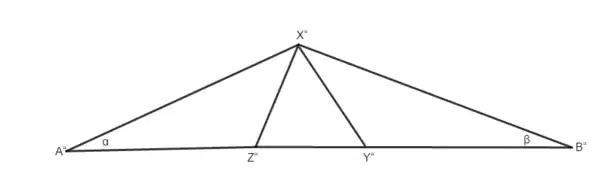
We consider 3 different cases for the geometric proof
- [1] $\gamma < 30 \degrees $
- [2] $\gamma > 30 \degrees $
- [3] $\gamma = 30 \degrees $
The outline for proving case [1] is given as follows:
- Construct $\triangle A' 'Y' 'X' '$.
- Construct $\triangle B' 'X' 'Z' ' $.
- Prove that $\triangle A' 'X' 'B' ' \cong \triangle AXB$.
- Prove that $\triangle A'X'B' \sim \triangle AXB$.
We construct triangle $\triangle A' 'Y' 'X' '$ such that $\triangle A' 'Y' 'X' ' \cong \triangle AYX $.
| \(\ds \therefore \angle X' 'Y' 'A' '\) | \(=\) | \(\ds \angle XYA\) | ||||||||||||
| \(\ds \) | \(=\) | \(\ds 60 \degrees + \gamma\) | by the construction of $\triangle XYA$ |
Next, we construct triangle $\triangle B' 'X' 'Z' ' $ as follows:
| \(\ds \angle Z' 'X' 'Y' '\) | \(=\) | \(\ds 60 \degrees - 2 \gamma\) | construct $\angle Z' 'X' 'Y' '$ | |||||||||||
| \(\ds \leadsto \angle X' 'Z' 'B' ' '\) | \(=\) | \(\ds 180 \degrees - \angle X' 'Y' 'A' ' - \angle Z' 'X' 'Y' ' '\) | ||||||||||||
| \(\ds \) | \(=\) | \(\ds 180 \degrees - (60 \degrees + \gamma) - (60 \degrees - 2 \gamma)\) | ||||||||||||
| \(\ds \) | \(=\) | \(\ds 60 \degrees + \gamma\) | ||||||||||||
| \(\ds \) | \(=\) | \(\ds \angle XZB\) | by the construction of $\triangle XZB$ | |||||||||||
| \(\ds \therefore X' 'Z' '\) | \(=\) | \(\ds X' 'Y' '\) | $\triangle Y' 'X' 'Z' '$ is an isosceles by Triangle with Two Equal Angles is Isosceles | |||||||||||
| \(\ds \) | \(=\) | \(\ds XY\) | by $\triangle A' 'Y' 'X' ' \cong \triangle AYX $ | |||||||||||
| \(\ds \) | \(=\) | \(\ds XZ\) | by equilateral $\triangle XYZ$ construction | |||||||||||
| \(\ds \angle B' 'X' 'Z' '\) | \(=\) | \(\ds \angle BXZ\) | construct $\angle B' 'X' 'Z' '$ | |||||||||||
| \(\ds \) | \(=\) | \(\ds 60 \degrees +\alpha\) | by the construction of $\triangle XZB$ | |||||||||||
| \(\ds \therefore \triangle B' 'X' 'Z' '\) | \(\cong\) | \(\ds \triangle BXZ\) | Triangle Angle-Side-Angle Congruence |
We shall now prove that that $\triangle A' 'X' 'B' ' \cong \triangle AXB$.
We note that:
| \(\ds \angle X' 'A' 'Y' '\) | \(=\) | \(\ds \angle XAY\) | by $\triangle A' 'Y' 'X' ' \cong \triangle AYX $ | |||||||||||
| \(\ds \) | \(=\) | \(\ds \alpha\) | ||||||||||||
| \(\ds \angle X' 'B' 'Z' '\) | \(=\) | \(\ds \angle XBZ\) | by $\triangle B' 'X' 'Z' ' \cong \triangle BXZ$ | |||||||||||
| \(\ds \) | \(=\) | \(\ds \beta\) | ||||||||||||
| \(\ds \angle AXB\) | \(=\) | \(\ds 180 \degrees - \angle XAY -\angle XBZ\) | ||||||||||||
| \(\ds \) | \(=\) | \(\ds 180 \degrees - \alpha - \beta\) | ||||||||||||
| \(\ds \angle A' 'X' 'B' '\) | \(=\) | \(\ds 180 \degrees - \angle X' 'A' 'Y' ' - \angle X' 'B' 'Z' '\) | ||||||||||||
| \(\ds \) | \(=\) | \(\ds 180 \degrees - \alpha - \beta\) | ||||||||||||
| \(\ds \) | \(=\) | \(\ds \angle AXB\) |
| \(\ds B' 'X' '\) | \(=\) | \(\ds BX\) | by $\triangle B' 'X' 'Z' ' \cong \triangle BXZ$ | |||||||||||
| \(\ds A' 'X' '\) | \(=\) | \(\ds AX\) | by $\triangle A' 'Y' 'X' ' \cong \triangle AYX $ | |||||||||||
| \(\ds \therefore \triangle AXB\) | \(\cong\) | \(\ds \triangle A' 'X' 'B' '\) | Triangle Side-Angle-Side Congruence |
Consequently,
| \(\ds \angle XBA\) | \(=\) | \(\ds \angle X' 'B' 'A' '\) | ||||||||||||
| \(\ds \) | \(=\) | \(\ds \beta\) | ||||||||||||
| \(\ds \angle XAB\) | \(=\) | \(\ds \angle X' 'A' 'B' '\) | ||||||||||||
| \(\ds \) | \(=\) | \(\ds \alpha\) |
and given that:
| \(\ds \angle X'B'A'\) | \(=\) | \(\ds \beta\) | ||||||||||||
| \(\ds \angle X'A'B'\) | \(=\) | \(\ds \alpha\) |
yields the desired result:
| \(\ds \triangle A'X'B'\) | \(\sim\) | \(\ds \triangle AXB\) | Triangles with Two Equal Angles are Similar |
For case [2], where $\gamma > 30 \degrees$, $\angle Z' 'X' 'Y' ' = 2 \gamma - 60 \degrees$ and
$\triangle X' 'Z' 'Y' '$ is external to $\triangle A' 'Y' 'X' '$ and $\triangle B' 'X' 'Z' '$.
In case [3], where $\gamma = 30 \degrees $, $\angle Z' 'X' 'Y' ' = 0 \degrees$ and $\triangle X' 'Z' 'Y' '$ degenerates into line segment $X' 'Z' '$.
In either case, [2] or [3], the proof for $\triangle X'A'B' \sim \triangle XAB$ is very similar to the proof for case [1].
In a similar fashion, we can prove that:
- $\triangle B'Z'C' \sim \triangle BZC$ and $\triangle A'Y'C' \sim \triangle AYC$
and that:
- $\angle CAY = \alpha $, $\angle ACY = \gamma $, $\angle CBZ = \beta $ and $\angle BCZ = \gamma $.
--- End of the Geometric Proof for $\triangle A'X'B' \sim \triangle AXB$ ---
Because
| \(\ds \angle ABC\) | \(=\) | \(\ds \angle ABX + \angle XBZ + \angle ZBC\) | ||||||||||||
| \(\ds \) | \(=\) | \(\ds 3 \beta\) |
- and
| \(\ds \angle BAC\) | \(=\) | \(\ds \angle BAX + \angle XAY + \angle CAY\) | ||||||||||||
| \(\ds \) | \(=\) | \(\ds 3 \alpha\) |
we have the following similarity:
| \(\ds \triangle ABC\) | \(\sim\) | \(\ds \triangle A'B'C'\) | Triangles with Two Equal Angles are Similar |
Using $ \triangle ABC \sim \triangle A'B'C' $, $\triangle A'B'X' \sim \triangle ABX$ and $\triangle A'C'Y' \sim \triangle ACY$ triangle similarities, we observe that:
| \(\ds \dfrac {AX} { A'X' }\) | \(=\) | \(\ds \dfrac {AB} { A'B' }\) | by $\triangle A'B'X' \sim \triangle ABX$ | |||||||||||
| \(\ds \dfrac {AY} { A'Y' }\) | \(=\) | \(\ds \dfrac {AC} { A'C' }\) | by $\triangle A'C'Y' \sim \triangle ACY$ | |||||||||||
| \(\ds \) | \(=\) | \(\ds \dfrac {AB} { A'B' }\) | by $ \triangle ABC \sim \triangle A'B'C' $ | |||||||||||
| \(\ds \leadsto \dfrac {AX} { A'X' }\) | \(=\) | \(\ds \dfrac {AY} { A'Y' }\) | the 2 ratios are equal to $\dfrac {AB} { A'B'}$ |
Furthermore,
| \(\ds \angle XAY\) | \(=\) | \(\ds \angle X'A'Y'\) | ||||||||||||
| \(\ds \) | \(=\) | \(\ds \alpha\) | ||||||||||||
| \(\ds \therefore \triangle XAY\) | \(\sim\) | \(\ds \triangle X'A'Y'\) | Triangles with One Equal Angle and Two Sides Proportional are Similar | |||||||||||
| \(\ds \leadsto \dfrac { XY } { X'Y' }\) | \(=\) | \(\ds \dfrac {AX} { A'X' }\) | ||||||||||||
| \(\ds \) | \(=\) | \(\ds \dfrac {AB} { A'B' }\) | by $\triangle A'B'X' \sim \triangle ABX$ |
In a similar fashion, we can also prove the following triangle similarities:
| \(\ds \triangle XBZ\) | \(\sim\) | \(\ds \triangle X'B'Z'\) | ||||||||||||
| \(\ds \triangle YCZ\) | \(\sim\) | \(\ds \triangle Y'C'Z'\) |
which yield the following:
| \(\ds \dfrac {XZ} { X'Z' }\) | \(=\) | \(\ds \dfrac { BX } { B'X' }\) | by $\triangle XBZ \sim \triangle X'B'Z'$ | |||||||||||
| \(\ds \) | \(=\) | \(\ds \dfrac {AB} { A'B' }\) | by $\triangle A'B'X' \sim \triangle ABX$ |
| \(\ds \dfrac {YZ} { Y'Z' }\) | \(=\) | \(\ds \dfrac { CY } { C'Y' }\) | by $\triangle YCZ \sim \triangle Y'C'Z'$ | |||||||||||
| \(\ds \) | \(=\) | \(\ds \dfrac {AC} { A'C' }\) | by $\triangle A'C'Y' \sim \triangle ACY$ | |||||||||||
| \(\ds \) | \(=\) | \(\ds \dfrac {AB} { A'B'}\) | by $\triangle A'B'C' \sim \triangle ABC$ |
| \(\ds \therefore \dfrac {XY} { X'Y' }\) | \(=\) | \(\ds \dfrac {XZ} { X'Z' } = \dfrac {YZ} { Y'Z' }\) | the 3 ratios are all equal to $\dfrac {AB} { A'B'}$ |
By construction:
| \(\ds XY\) | \(=\) | \(\ds XZ = YZ\) | ||||||||||||
| \(\ds \therefore \dfrac {XY} { X'Y' }\) | \(=\) | \(\ds \dfrac {XY} { X'Z' } = \dfrac {XY} { Y'Z' }\) |
| \(\ds \leadsto X'Y'\) | \(=\) | \(\ds X'Z' = Y'Z'\) |
Hence, $\triangle X'Y'Z'$ is an equilateral triangle, which proves the theorem.
$\blacksquare$
Also known as
is also known just as Morley's Theorem.
Source of Name
This entry was named for Frank Morley.
Historical Note
was proved by Frank Morley in $1899$.
Sources
- 1991: David Wells: Curious and Interesting Geometry ... (next): Morley's triangle
- 2008: David Nelson: The Penguin Dictionary of Mathematics (4th ed.) ... (previous) ... (next): Morley's theorem