Napier's Rules of Circular Parts
Theorem
Napier's Rules for Right Spherical Triangles
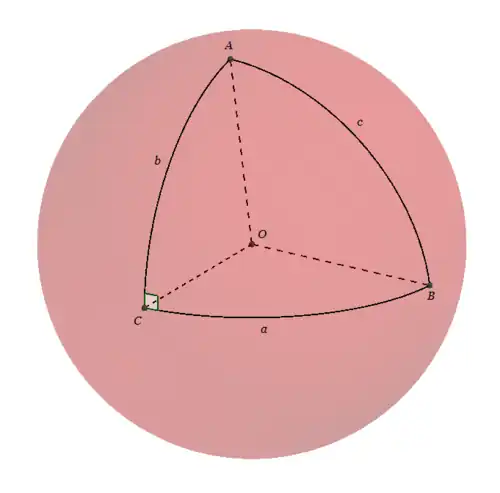
Let $\triangle ABC$ be a right spherical triangle on the surface of a sphere whose center is $O$ such that the angle $\sphericalangle C$ is a right angle.
Let the sides $a, b, c$ of $\triangle ABC$ be measured by the angles subtended at $O$, where $a, b, c$ are opposite $A, B, C$ respectively.
Let the remaining parts of $\triangle ABC$ be arranged according to the interior of this circle, where the symbol $\Box$ denotes a right angle.
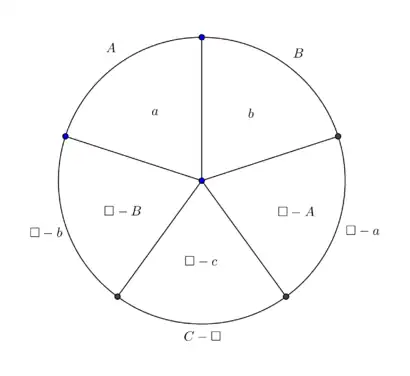
Let one of the parts of this circle be called a middle part.
Let the two neighboring parts of the middle part be called adjacent parts.
Let the remaining two parts be called opposite parts.
Then:
- The sine of the middle part equals the product of the tangents of the adjacent parts.
- The sine of the middle part equals the product of the cosines of the opposite parts.
Napier's Rules for Quadrantal Triangles
Napier's Rules for Quadrantal Triangles are the special cases of the Spherical Law of Cosines for a quadrantal triangle.
Recall the definition of Quadrantal Spherical Triangle:
Let $\triangle ABC$ be a spherical triangle.
Let one of the sides of $\triangle ABC$ be a right angle: $\dfrac \pi 2$.
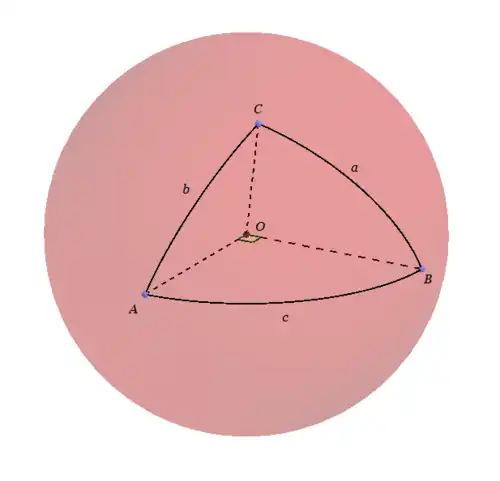
Then $\triangle ABC$ is known as a quadrantal spherical triangle.
Hence, let $\triangle ABC$ be a quadrantal triangle on the surface of a sphere whose center is $O$.
Let the sides $a, b, c$ of $\triangle ABC$ be measured by the angles subtended at $O$, where $a, b, c$ are opposite $A, B, C$ respectively.
Let side $c$ be a right angle.
Let the remaining parts of $\triangle ABC$ be arranged according to the exterior of this circle, where the symbol $\Box$ denotes a right angle.
Let one of the parts of this circle be called a middle part.
Let the two neighboring parts of the middle part be called adjacent parts.
Let the remaining two parts be called opposite parts.
Then:
- The sine of the middle part equals the product of the tangents of the adjacent parts.
- The sine of the middle part equals the product of the cosines of the opposite parts.
Source of Name
This entry was named for John Napier.
Sources
- 1976: W.M. Smart: Textbook on Spherical Astronomy (6th ed.) ... (previous) ... (next): Chapter $\text I$. Spherical Trigonometry: $10$. Right-angled and quadrantal triangles.
- 1998: David Nelson: The Penguin Dictionary of Mathematics (2nd ed.) ... (previous) ... (next): Napier's rules of circular parts
- 2008: David Nelson: The Penguin Dictionary of Mathematics (4th ed.) ... (previous) ... (next): Napier's rules of circular parts