Parallelism is Transitive Relation
Theorem
Parallelism between straight lines is a transitive relation.
In the words of Euclid:
- Straight lines parallel to the same straight line are also parallel to one other.
(The Elements: Book $\text{I}$: Proposition $30$)
Proof
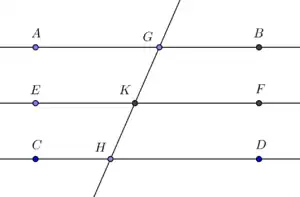
Let the straight lines $AB$ and $CD$ both be parallel to the straight line $EF$.
Let the straight line $GK$ be a transversal that cuts the parallel lines $AB$ and $EF$.
By Parallelism implies Equal Alternate Angles:
- $\angle AGK = \angle GHF$
By Playfair's Axiom, there is only one line that passes through $H$ that is parallel to $CD$ (namely $EF$).
Therefore the transversal $GK$ cannot be parallel to $CD$.
Hence the two lines must therefore intersect.
The straight line $GK$ also cuts the parallel lines $EF$ and $CD$.
So from Parallelism implies Equal Corresponding Angles:
- $\angle GHF = \angle GKD$.
Thus $\angle AGK = \angle GKD$.
So from Equal Alternate Angles implies Parallel Lines:
- $AB \parallel CD$
$\blacksquare$
Also see
Historical Note
This proof is Proposition $30$ of Book $\text{I}$ of Euclid's The Elements.
Note that while this result applies to all parallel lines in Euclidean geometry, this proof is only valid when all three lines are in the same plane.
Sources
- 1926: Sir Thomas L. Heath: Euclid: The Thirteen Books of The Elements: Volume 1 (2nd ed.) ... (previous) ... (next): Book $\text{I}$. Propositions
- 1964: Steven A. Gaal: Point Set Topology ... (previous) ... (next): Introduction to Set Theory: $1$. Elementary Operations on Sets
- 1968: M.N. Aref and William Wernick: Problems & Solutions in Euclidean Geometry ... (previous) ... (next): Chapter $1$: Triangles and Polygons: Theorems and Corollaries $1.7$