Pascal's Theorem
Theorem
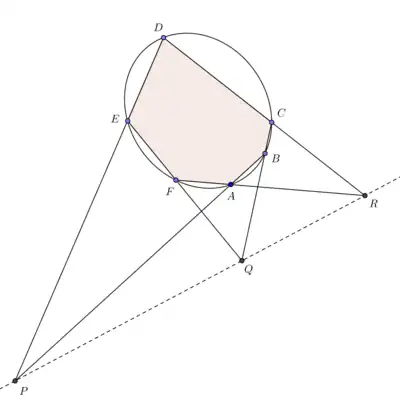
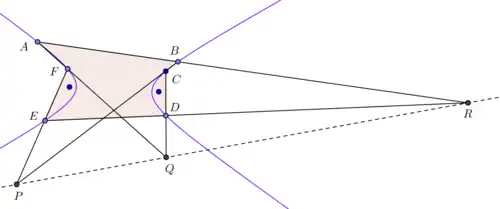
Let $ABCDEF$ be a hexagon whose $6$ vertices lie on a conic section and whose opposite sides are not parallel.
Then the points of intersection of the opposite sides, when produced as necessary, all lie on a straight line.
Proof
 | This theorem requires a proof. You can help $\mathsf{Pr} \infty \mathsf{fWiki}$ by crafting such a proof. To discuss this page in more detail, feel free to use the talk page. When this work has been completed, you may remove this instance of {{ProofWanted}} from the code.If you would welcome a second opinion as to whether your work is correct, add a call to {{Proofread}} the page. |
Also known as
Some sources give as Pascal's mystic hexagram theorem, but that is strictly speaking a specific instance of this more general theorem.
Also see
- Pascal's Mystic Hexagram, a variant of this
- Brianchon's Theorem
Source of Name
This entry was named for Blaise Pascal.
Historical Note
was discovered by Blaise Pascal when he was in his mid-teens, in the wake of his encounter with Euclid's The Elements.
He published it in his Essay pour les Coniques, which contains $400$ or so corollaries deduced from it, formed by allowing pairs of the six points involved to merge into coincidence.
James Joseph Sylvester called this theorem:
- a sort of cat's cradle.
Sources
- 1937: Eric Temple Bell: Men of Mathematics ... (previous) ... (next): Chapter $\text{V}$: "Greatness and Misery of Man"
- 1986: David Wells: Curious and Interesting Numbers ... (previous) ... (next): $6$
- 1989: Ephraim J. Borowski and Jonathan M. Borwein: Dictionary of Mathematics ... (previous) ... (next): Pascal's mystic hexagram theorem
- 1992: George F. Simmons: Calculus Gems ... (previous) ... (next): Chapter $\text {A}.16$: Pascal ($\text {1623}$ – $\text {1662}$)
- 1997: David Wells: Curious and Interesting Numbers (2nd ed.) ... (previous) ... (next): $6$
- 1998: David Nelson: The Penguin Dictionary of Mathematics (2nd ed.) ... (previous) ... (next): Pascal's theorem
- 2008: David Nelson: The Penguin Dictionary of Mathematics (4th ed.) ... (previous) ... (next): Pascal's theorem
- This article incorporates material from proof of Pascal's mystic hexagram on PlanetMath, which is licensed under the Creative Commons Attribution/Share-Alike License.