Proportional Numbers have Proportional Differences
Theorem
In the words of Euclid:
- If, as a whole is to a whole, so is a number subtracted to a number subtracted, the remainder will also be to the remainder as whole to whole.
(The Elements: Book $\text{VII}$: Proposition $11$)
That is:
- $a : b = c : d \implies \left({a - c}\right) : \left({b - d}\right) = a : b$
where $a : b$ denotes the ratio of $a$ to $b$.
Proof
As the whole $AB$ is to the whole $CD$, so let the $AE$ subtracted be to $CF$ subtracted.
We need to show that $EB : FD = AB : CD$.
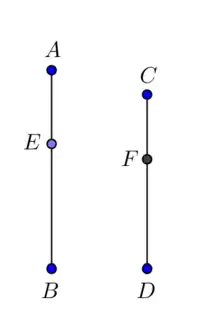
We have that :$AB : CD = AE : CF$.
So from Book $\text{VII}$ Definition $20$: Proportional we have that whatever aliquot part or aliquant part $AB$ is of $CD$, the same aliquot part or aliquant part is $AE$ of $CF$.
So from:
and:
$EB$ is the same aliquot part or aliquant part of $FD$ that $AB$ is of $CD$.
So by Book $\text{VII}$ Definition $20$: Proportional $EB : FD = AB : CD$.
$\blacksquare$
Historical Note
This proof is Proposition $11$ of Book $\text{VII}$ of Euclid's The Elements.
Sources
- 1926: Sir Thomas L. Heath: Euclid: The Thirteen Books of The Elements: Volume 2 (2nd ed.) ... (previous) ... (next): Book $\text{VII}$. Propositions