Pythagoras's Theorem/Proof 5
Theorem
Let $\triangle ABC$ be a right triangle with $c$ as the hypotenuse.
Then:
- $a^2 + b^2 = c^2$
Proof
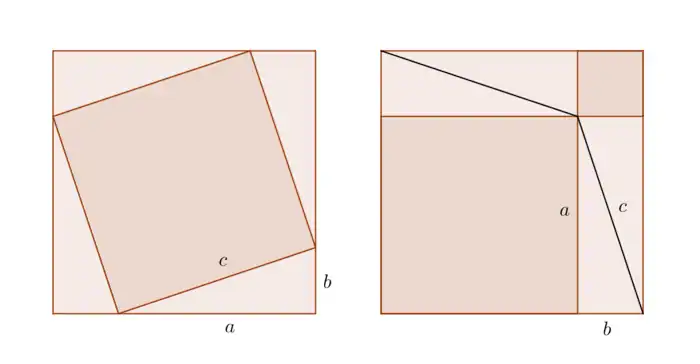
The two squares both have the same area, that is, $\paren {a + b}^2$.
The one on the left has four triangles of area $\dfrac {a b} 2$ and a square of area $c^2$.
The one on the right has four triangles of area $\dfrac {a b} 2$ and two squares: one of area $a^2$ and one of area $b^2$.
Take away the triangles from both of the big squares and you are left with $c^2 = a^2 + b^2$.
$\blacksquare$
Source of Name
This entry was named for Pythagoras of Samos.
Historical Note
This proof is the basis of the Aldous Huxley short story Young Archimedes.
Sources
- 1992: George F. Simmons: Calculus Gems ... (previous) ... (next): Chapter $\text {B}.1$: The Pythagorean Theorem
- 2014: Christopher Clapham and James Nicholson: The Concise Oxford Dictionary of Mathematics (5th ed.) ... (previous) ... (next): Pythagoras' Theorem
- For a video presentation of the contents of this page, visit the Khan Academy.