Pythagoras's Theorem/Short Algebraic Proof
 | This article needs to be tidied. In particular: need a new picture - split c into 2 parts Please fix formatting and $\LaTeX$ errors and inconsistencies. It may also need to be brought up to our standard house style. To discuss this page in more detail, feel free to use the talk page. When this work has been completed, you may remove this instance of {{Tidy}} from the code. |
Theorem
Let $\triangle ABC$ be a right triangle with $c$ as the hypotenuse.
Then:
- $a^2 + b^2 = c^2$
Proof
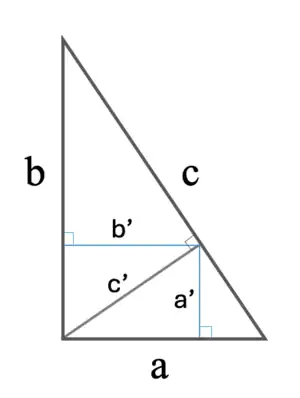
From Perpendicular in Right-Angled Triangle makes two Similar Triangles, we have that $\triangle c'c_{upper}b$ is similar to $\triangle c_{lower}c'a$ is similar to $\triangle abc$
 | Although this article appears correct, it's inelegant. There has to be a better way of doing it. In particular: probably better to refer to triangles by their vertices than their sides, makes it easier for several reasons You can help $\mathsf{Pr} \infty \mathsf{fWiki}$ by redesigning it. To discuss this page in more detail, feel free to use the talk page. When this work has been completed, you may remove this instance of {{Improve}} from the code.If you would welcome a second opinion as to whether your work is correct, add a call to {{Proofread}} the page. |
Looking at the hypotenuse and altitudes of the three similar triangles, we can write the following products and ratios relationships, then multiply them:
Twice the area of the lower right triangle plus twice the area of the upper right triangle equals twice the area of the entire right triangle.
| \(\ds a a' + b b'\) | \(=\) | \(\ds c c'\) | Area of Triangle in Terms of Side and Altitude | |||||||||||
| \(\ds \dfrac {a} {a′}\) | \(=\) | \(\, \ds \dfrac {b} {b′} \, \) | \(\, \ds = \, \) | \(\ds \dfrac {c} {c′}\) | ratios | |||||||||
| \(\ds \leadsto \ \ \) | \(\ds a^2 + b^2\) | \(=\) | \(\ds c^2\) |
Note, dividing them gives us: $ {a′}^2 + {b′}^2 = {c′}^2$
Source of Name
This entry was named for Pythagoras of Samos.