Pythagorean Triangle/Examples/6-8-10
Example of Pythagorean Triangle
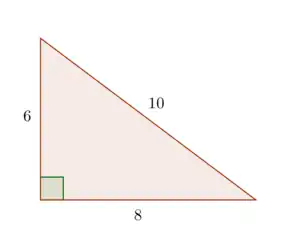
The triangle whose sides are of length $6$, $8$ and $10$ is a Pythagorean triangle.
This is not a primitive Pythagorean triangle.
Proof
| \(\ds 6^2 + 8^2\) | \(=\) | \(\ds 2^2 \times 3^2 + 2^2 \times 4^2\) | ||||||||||||
| \(\ds \) | \(=\) | \(\ds 4 \times \paren {9 + 16}\) | ||||||||||||
| \(\ds \) | \(=\) | \(\ds 4 \times 25\) | ||||||||||||
| \(\ds \) | \(=\) | \(\ds 2^2 \times 5^2\) | ||||||||||||
| \(\ds \) | \(=\) | \(\ds 10^2\) |
It follows by Pythagoras's Theorem that $6$, $8$ and $10$ form a Pythagorean triple.
Note that $6$ and $8$ are not coprime as $\gcd \set {6, 8} = 2$.
Hence, by definition, $6$, $8$ and $10$ do not form a primitive Pythagorean triple.
The result follows by definition of a primitive Pythagorean triangle.
$\blacksquare$
Sources
- 1986: David Wells: Curious and Interesting Numbers ... (previous) ... (next): $13$
- 1997: David Wells: Curious and Interesting Numbers (2nd ed.) ... (previous) ... (next): $13$