Rectangle is Parallelogram
Theorem
Let $ABCD$ be a rectangle.
Then $ABCD$ is a parallelogram.
Proof
Let $ABCD$ be a rectangle.
Aiming for a contradiction, suppose $ABCD$ is not a parallelogram.
Without loss of generality, let line segments $AB$ and $CD$ not be parallel.
By Euclid's Second Postulate, let us produce $AB$ and $CD$ into two infinite straight lines.
By the Parallel Postulate, the $AD$ and $BC$ will eventually meet at one side or the other.
Let their point of intersection be $E$.
There are two possibilities:
- $ADE$ is a triangle
- $CBE$ is a triangle.
Without loss of generality, let $\triangle ADE$ be a triangle:
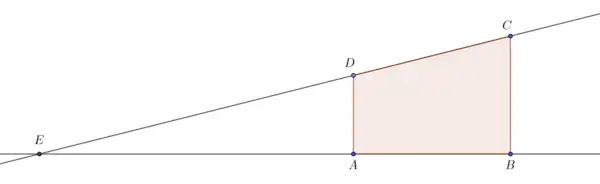
By Sum of Angles of Triangle equals Two Right Angles, $\angle ADE + \angle DEA + \angle EAD$ add to two right angles.
But by the definition of a rectangle, $\angle ADE + \angle EAD$ add to two right angles.
As $\angle DEA$ is not a zero angle (else $\triangle ADE$ would not be a triangle), this cannot be so.
Hence $ABCD$ is not a rectangle.
But by hypothesis, $ABCD$ is a rectangle.
This is a contradiction.
Hence by Proof by Contradiction, $AB$ and $CD$ are parallel.
The same argument can be used to demonstrate that $AD$ and $BC$ are also parallel.
Hence the result by definition of parallelogram.
$\blacksquare$