Relative Sizes of Components of Ratios
Theorem
In the words of Euclid:
- If a first magnitude have to a second the same ratio as a third has to a fourth, and the first be greater than the third, the second will also be greater than the fourth; if equal, equal; and if less, less.
(The Elements: Book $\text{V}$: Proposition $14$)
That is, if $a : b = c : d$ then:
- $a > c \implies b > d$
- $a = c \implies b = d$
- $a < c \implies b < d$
Proof
Let a first magnitude $A$ have the same ratio to a second $B$ as a third $C$ has to a fourth $D$.
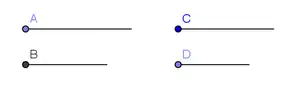
Let $A > C$.
Then from Relative Sizes of Ratios on Unequal Magnitudes $A : B > C : B$.
But $A : B = C : D$.
So from Relative Sizes of Proportional Magnitudes $C : D > C : B$.
But from Relative Sizes of Magnitudes on Unequal Ratios $D > B$.
$\Box$
In a similar way it can be shown that:
- if $A = C$ then $B = D$
- if $A < C$ then $B < D$
$\blacksquare$
Historical Note
This proof is Proposition $14$ of Book $\text{V}$ of Euclid's The Elements.
Sources
- 1926: Sir Thomas L. Heath: Euclid: The Thirteen Books of The Elements: Volume 2 (2nd ed.) ... (previous) ... (next): Book $\text{V}$. Propositions