Sam Loyd's Missing Square
Paradox
Consider a square of side length $13$.
Let it be divided into:
- a $13 \times 5$ rectangle, divided into two right triangles by its diagonal
- a $13 \times 8$ rectangle, divided into trapezia with side lengths $8$ and $5$:
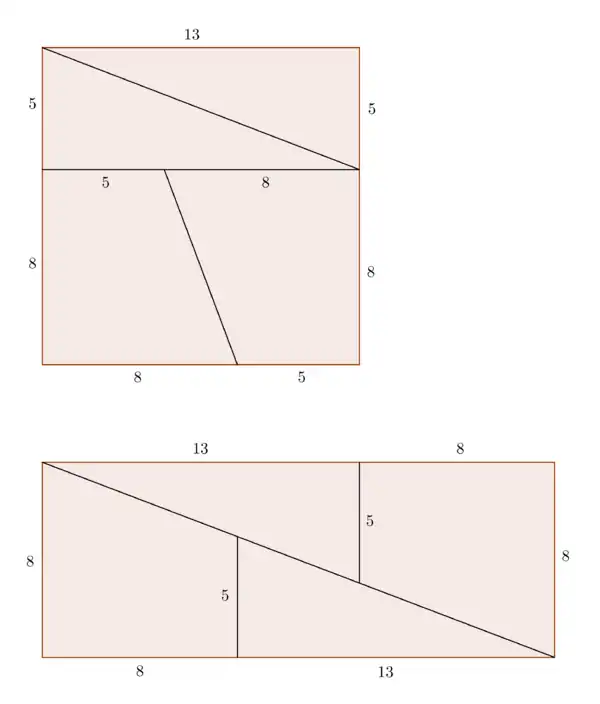
Let the pieces be rearranged to form two long right triangles arranged to form a $21 \times 8$ rectangle.
The area of the square is $13 \times 13 = 169$.
The area of the rectangle is $21 \times 8 = 168$.
Where did the missing $1 \times 1$ square go?
Variant
You have a square which is made from $4$ large triangles, $4$ small triangles, $4$ irregular octagons and $4$ small squares.
You jumble them up and reassemble the pieces once again into that same large square, but this time there is a hole in the middle.
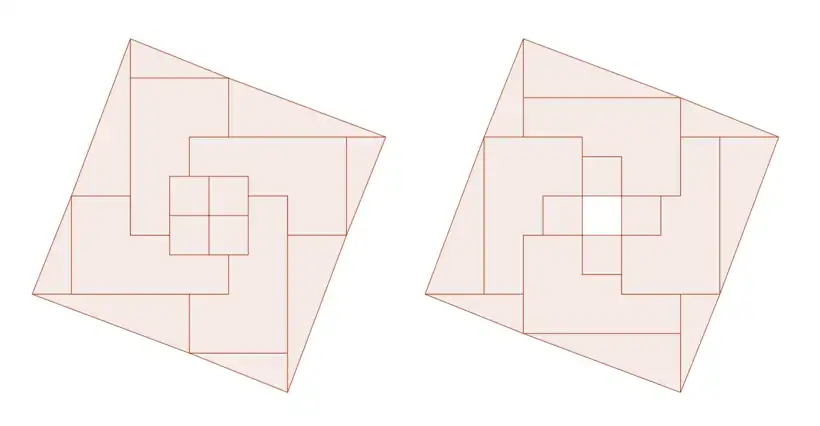
Where did that hole come from?
Resolution
This is a falsidical paradox.
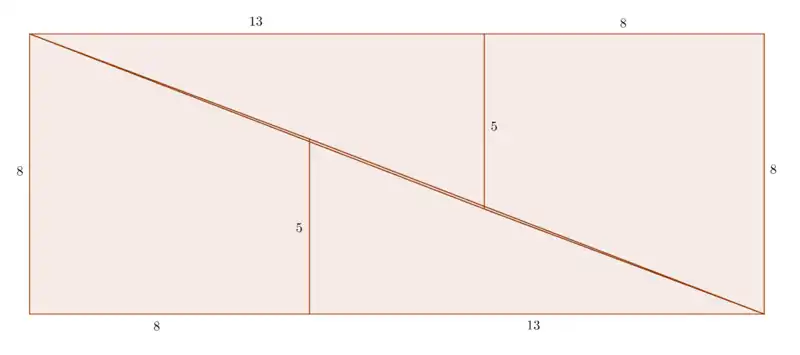
When you place the $13 \times 5$ right triangle against the trapezium, supposedly to make a $21 \times 8$ right triangle, the hypotenuse of that figure is not actually straight.
When the $21 \times 8$ rectangle is drawn accurately, you will see an overlap:
It is noted that $5$, $8$ and $13$ are consecutive Fibonacci numbers.
From Cassini's Identity:
- $F_n^2 = F_{n - 1} F_{n + 1} \pm 1$
Hence the resolution.
$\blacksquare$
Source of Name
This entry was named for Sam Loyd.
Historical Note
While puzzle has Sam Loyd's name attached to it, it appears to have been first published in $1774$ in Rational Recreations by William Hooper, about whom little seems to be known.
Sources
- 1986: David Wells: Curious and Interesting Numbers ... (previous) ... (next): $5$
- 1992: David Wells: Curious and Interesting Puzzles ... (previous) ... (next): The Vanishing Square Paradox: $143$
- 1997: David Wells: Curious and Interesting Numbers (2nd ed.) ... (previous) ... (next): $5$