Sine and Cosine are Periodic on Reals
Theorem
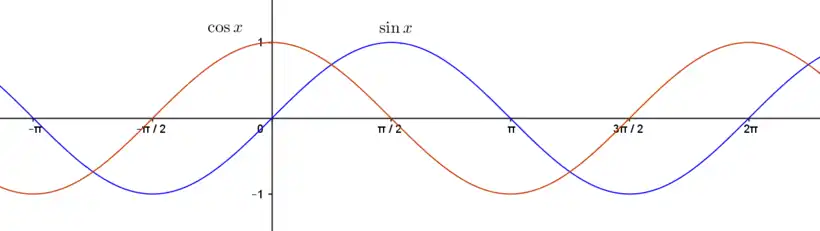
The real sine function and real cosine function are periodic on the set of real numbers $\R$:
Real Cosine Function is Periodic
- $\exists L \in \R_{\neq 0}: \forall x \in \R: \cos x = \map \cos {x + L}$
Real Sine Function is Periodic
The real sine function is periodic with the same period as the real cosine function.
Pi
The real number $\pi$ (called pi, pronounced pie) is uniquely defined as:
- $\pi := \dfrac p 2$
where $p \in \R$ is the period of $\sin$ and $\cos$.
Cosine of Angle plus Straight Angle
- $\map \cos {x + \pi} = -\cos x$
Sine of Angle plus Straight Angle
- $\map \sin {x + \pi} = -\sin x$
Sign of Cosine on $\openint {-\dfrac \pi 2} {\dfrac \pi 2}$ and $\openint {\dfrac \pi 2} {\dfrac {3 \pi} 2}$
- $\cos x$ is strictly positive on the interval $\openint {-\dfrac \pi 2} {\dfrac \pi 2}$ and strictly negative on the interval $\openint {\dfrac \pi 2} {\dfrac {3 \pi} 2}$
Sign of Sine on $\openint 0 \pi$ and $\openint \pi {2 \pi}$
- $\sin x$ is strictly positive on the interval $\openint 0 \pi$ and strictly negative on the interval $\openint \pi {2 \pi}$
Zeroes of Cosine
- $\cos x = 0$ if and only if $x = \paren {n + \dfrac 1 2} \pi$ for some $n \in \Z$.
Zeroes of Sine
- $\sin x = 0$, if and only if $x = n \pi$ for some $n \in \Z$.
Note
Given that we have defined sine and cosine in terms of a power series, it is a plausible proposition to define $\pi$ using the same language.
$\pi$ is, of course, the famous irrational constant $3.14159 \ldots$.
Sources
- 1960: Walter Ledermann: Complex Numbers ... (previous) ... (next): $\S 2$. Geometrical Representations
- 1977: K.G. Binmore: Mathematical Analysis: A Straightforward Approach ... (previous) ... (next): $\S 16.4$