Sine of 30 Degrees
Theorem
- $\sin 30 \degrees = \sin \dfrac \pi 6 = \dfrac 1 2$
where $\sin$ denotes the sine function.
Proof
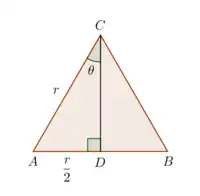
Let $\triangle ABC$ be an equilateral triangle of side $r$.
By definition, each angle of $\triangle ABC$ is equal.
From Sum of Angles of Triangle equals Two Right Angles it follows that each angle measures $60^\circ$.
Let $CD$ be a perpendicular dropped from $C$ to $AB$ at $D$.
Then $AD = \dfrac r 2$ while:
- $\angle ACD = \dfrac {60 \degrees} 2 = 30 \degrees$
So by definition of sine function:
- $\sin \paren {\angle ACD} = \dfrac {r / 2} r = \dfrac 1 2$
$\blacksquare$
Sources
- 1953: L. Harwood Clarke: A Note Book in Pure Mathematics ... (previous) ... (next): $\text V$. Trigonometry: Special angles
- 1968: Murray R. Spiegel: Mathematical Handbook of Formulas and Tables ... (previous) ... (next): $\S 5$: Trigonometric Functions: Exact Values for Trigonometric Functions of Various Angles
- 1998: David Nelson: The Penguin Dictionary of Mathematics (2nd ed.) ... (previous) ... (next): trigonometric function
- 2008: David Nelson: The Penguin Dictionary of Mathematics (4th ed.) ... (previous) ... (next): trigonometric function
- 2014: Christopher Clapham and James Nicholson: The Concise Oxford Dictionary of Mathematics (5th ed.) ... (previous) ... (next): Appendix $12$: Trigonometric formulae: Trigonometric values for some special angles
- 2021: Richard Earl and James Nicholson: The Concise Oxford Dictionary of Mathematics (6th ed.) ... (previous) ... (next): Appendix $14$: Trigonometric formulae: Trigonometric values for some special angles