Straight Line cannot be in Two Planes
Theorem
In the words of Euclid:
- A part of a straight line cannot be in the plane of reference and part in a plane more elevated.
(The Elements: Book $\text{XI}$: Proposition $1$)
Proof
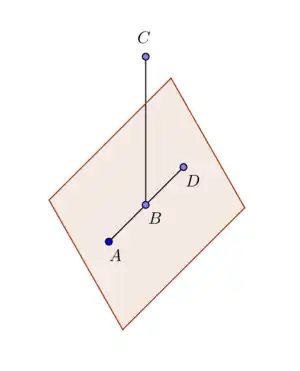
Suppose it were possible to have a straight line in more than one plane.
Let a part $AB$ of the straight line $ABC$ be in the plane of reference, and another part $BC$ be in a plane more elevated.
There will then be in the plane of reference some straight line $BD$ continuous with $AB$ in a straight line.
Therefore $AB$ is a common segment of the two straight lines $ABC$ and $ABD$.
Suppose a circle is described with center $B$ and radius $AB$.
Then the diameters would cut off unequal arcs of the circle.
Hence the result.
$\blacksquare$
Historical Note
This proof is Proposition $1$ of Book $\text{XI}$ of Euclid's The Elements.
Sources
- 1926: Sir Thomas L. Heath: Euclid: The Thirteen Books of The Elements: Volume 3 (2nd ed.) ... (previous) ... (next): Book $\text{XI}$. Propositions