Symmetry Group of Equilateral Triangle is Group
Theorem
The symmetry group of the equilateral triangle is a group.
Definition
Recall the definition of the symmetry group of the equilateral triangle:
Let $\triangle ABC$ be an equilateral triangle.
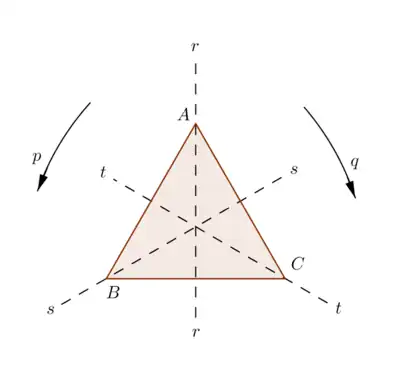
We define in cycle notation the following symmetries on $\triangle ABC$:
| \(\ds e\) | \(:\) | \(\ds \tuple A \tuple B \tuple C\) | Identity mapping | |||||||||||
| \(\ds p\) | \(:\) | \(\ds \tuple {ABC}\) | Rotation of $120 \degrees$ anticlockwise about center | |||||||||||
| \(\ds q\) | \(:\) | \(\ds \tuple {ACB}\) | Rotation of $120 \degrees$ clockwise about center | |||||||||||
| \(\ds r\) | \(:\) | \(\ds \tuple {BC}\) | Reflection in line $r$ | |||||||||||
| \(\ds s\) | \(:\) | \(\ds \tuple {AC}\) | Reflection in line $s$ | |||||||||||
| \(\ds t\) | \(:\) | \(\ds \tuple {AB}\) | Reflection in line $t$ |
Note that $r, s, t$ can equally well be considered as a rotation of $180 \degrees$ (in $3$ dimensions) about the axes $r, s, t$.
Then these six operations form a group.
This group is known as the symmetry group of the equilateral triangle.
Proof
Let us refer to this group as $D_3$.
Taking the group axioms in turn:
Group Axiom $\text G 0$: Closure
From the Cayley table it is seen directly that $D_3$ is closed.
$\Box$
Group Axiom $\text G 1$: Associativity
Composition of Mappings is Associative.
$\Box$
Group Axiom $\text G 2$: Existence of Identity Element
The identity is $e = (A) (B) (C)$.
$\Box$
Group Axiom $\text G 3$: Existence of Inverse Element
Each element can be seen to have an inverse:
- $p^{-1} = q$ and so $q^{-1} = p$
- $r$, $s$ and $t$ are all self-inverse.
$\Box$
Thus $D_3$ is seen to be a group.
$\blacksquare$
Sources
- 1966: Richard A. Dean: Elements of Abstract Algebra ... (previous) ... (next): $\S 1.3$: Example $9$
- 1971: Allan Clark: Elements of Abstract Algebra ... (previous) ... (next): Chapter $2$: The Definition of Group Structure: $\S 26 \eta$
- 1996: John F. Humphreys: A Course in Group Theory ... (previous) ... (next): Chapter $1$: Definitions and Examples: Example $1.9$