Total Solid Angle Subtended by Spherical Surface
Theorem
The total solid angle subtended by a spherical surface is $4 \pi$.
Proof
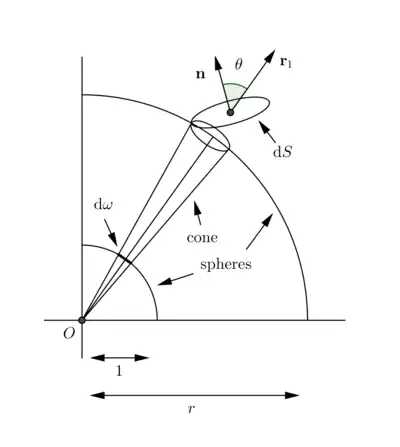
Let $\d S$ be an element of a surface $S$.
Let $\mathbf n$ be a unit normal on $\d S$ positive outwards.
From a point $O$, let a conical pencil touch the boundary of $S$.
Let $\mathbf r_1$ be a unit vector in the direction of the position vector $\mathbf r = r \mathbf r_1$ with respect to $O$.
Let spheres be drawn with centers at $O$ of radii $1$ and $r$.
Let $\d \omega$ be the area cut from the sphere of radius $1$.
We have:
- $\dfrac {\d \omega} {1^2} = \dfrac {\d S \cos \theta} {r^2}$
where $\theta$ is the angle between $\mathbf n$ and $\mathbf r$.
Thus $\d \omega$ is the solid angle subtended by $\d S$ at $O$.
Hence by definition of solid angle subtended:
- $\ds \Omega = \iint_S \frac {\mathbf {\hat r} \cdot \mathbf {\hat n} \rd S} {r^2}$
 | Work In Progress In particular: I've lost the thread of the source work. I will restart vector analysis from a different viewpoint, as the coverage of vector integration by Hague is not easy to interpret. You can help $\mathsf{Pr} \infty \mathsf{fWiki}$ by completing it. To discuss this page in more detail, feel free to use the talk page. When this work has been completed, you may remove this instance of {{WIP}} from the code. |
Sources
- 1951: B. Hague: An Introduction to Vector Analysis (5th ed.) ... (previous) ... (next): Chapter $\text {VI}$: The Theorems of Gauss and Stokes: $2$. Gauss's Theorem and the Inverse Square Law