Triangle Right-Angle-Hypotenuse-Side Congruence/Proof 2
Theorem
If two right triangles have:
- their hypotenuses equal
- another of their respective sides equal
they will also have:
- their third sides equal
- the remaining two angles equal to their respective remaining angles.
Proof
 | This article needs to be tidied. Please fix formatting and $\LaTeX$ errors and inconsistencies. It may also need to be brought up to our standard house style. To discuss this page in more detail, feel free to use the talk page. When this work has been completed, you may remove this instance of {{Tidy}} from the code. |
 | This article needs to be linked to other articles. You can help $\mathsf{Pr} \infty \mathsf{fWiki}$ by adding these links. To discuss this page in more detail, feel free to use the talk page. When this work has been completed, you may remove this instance of {{MissingLinks}} from the code. |
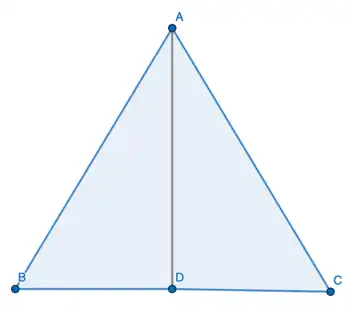
Let $\triangle ADB$ and $\triangle ADC$ both be right triangles.
Let them have equal hypotenuse and one leg ($AD$) equal.
by hypothesis:
- $AB = AC$
- $\angle ADB = \angle ADC = \ $ one right angle
- $AD$ is shared
So the two triangles can be drawn as shown with $BD$ and $DC$ joined at $D$.
By addition:
- $\angle BDA + \angle CDA = \angle BDC = \ $ two right angles
By Two Angles making Two Right Angles make Straight Line:
- $BDC$ is one straight line
- the points $BDC$ are collinear
So:
- $\triangle ABC$ is a triangle.
By definition of isosceles triangle:
- $\triangle ABC$ is isosceles.
Since $AD \perp BDC$, by definition of perpendicular bisector:
- $BD = DC$
By Triangle Side-Angle-Side Congruence:
- $\triangle ABD \cong \triangle ACD$
$\blacksquare$