7

I keep my sourdough starter in the fridge. When I want to use it (~once a week), I will take it out, give it about an hour, discard half, feed it, leave it for a couple of hours, and then begin my recipe.

I use half the starter for the recipe and feed what's left in the jar. However, this means the starter in the jar is fed twice within a couple of hours. This got me to think, how frequent is too frequent between feedings?

I get that I'm unlikely to 'kill' it doing this but are there any downsides?

3 Answers3

21

I'm going to guess from the mention of half at least twice in the question that you rigidly follow one of those "The only one true way to sourdough" methods that involves doubling, using half, throwing away half, etc.

I can report from actual experience that you can feed a volume of starter amounts inclusive from 10% of its volume to 400% of it's volume without any detrimental effect. Now, obviously 10% is more of a "tiding the starter over" feeding while 400% is serious bulking up and reduces the sourness if used soon, but it all works to make bread.

Thus, if you gave it "two feedings" separated by no hours at all, it would be fine. It's also fine to separate them by a few hours or 12-24 hours, in my experience.

The only things I've found important in some decades of observation is that the starter is fed right before it goes in the fridge, and that it is not abandoned too long without feeding when out of the fridge. But people locked into the rigid methods of some particular book are generally sure that one method in precise detail is the only true way. Perhaps it is for them. The bacteria and yeast culture don't have a publishing deal, and don't seem to care that much about minor details, mostly.

The rigid methods do have a tendency to mean that the result is always the same or very similar, if that's important to you. But in this case, if you are getting the result you like the way you do it, then it works, and there's no need to worry about "downsides" from continuing to do it that way. You can, of course, experiment with letting the starter go whatever period you find convenient before feeding it and returning it to the fridge, whether than be overnight or 24 hours, to see if that makes a difference that you like - but in general, there's not going to be a lot of difference (and may be undetectable) given it's just the pre-storage routine. Greater differences are noticeable in post storage treatment, where increasing much more than "double" will noticeably change the acidity (temporarily) and also tilts the balance in favor of yeast temporarily so the bread rises more easily/faster. More frequent feedings also do that. Smaller feedings and more time between feedings tilt the balance towards bacteria and more acidity, and some people run starters so far down that road that they need to add yeast to get the bread to rise.

Ecnerwal
  • 21,987
  • 36
  • 82
5

@ecnerwal has already given a good answer, so this is more of an extended comment posing as an answer.

I think it is important to understand that breadmaking is a very old art; there isn't just one correct way, or even one optimal way. For most of history I think it is reasonable to assume that people didn't measure ingredients or follow strict methods - you would use what you had at hand and with experience you would learn when things felt right; after a while, your results would be consistently good (ie. the way you wanted and/or expected). Sourdough was probably one of the many happy accident waiting to happen when you leave things for too long in a warm climate and then decide to try to save things because you don't waste sparse resources.

The modern trend is to obsess about precision and extreme control, using specialised equipment, which probably makes sense if you are an industrial baker, but is irrelevant when baking for your family, unless you have a very extensive one. It makes much more sense to focus on what you can call 'the intermediate results':

  • Is the starter good (ie, not mouldy, smells fresh etc)
  • When the dough has been mixed, does it feel right - stretchy, not too sticky, or whatever are your criteria
  • Did it rise as much as you want
  • Is the final bread as good as it should be

I generally keep my starter in the fridge for up to a month if I for some reason don't bake for a while. I may feed a bit to sort of wake it up, but more often I just mix it with warm water, just slightly warmer than hand warm, because it is cold from the fridge.

I mostly bake rye bread (consisting of nothing more than rye flour, water, a bit of salt, and sourdough starter), and the dough gets incredibly sticky, so my main check point is whether it is dry enough that I can handle it with leaving half of it on the hands. For wheat flour, you would look at stretch etc.

I never worry about how long things rise, I only care about how much - somethimes it takes an hour, sometimes up to 12 hours. Rye is possibly more tolerant in that respect.

Then I bake - that's it. Baking should be a joy, both when you bake and when you eat the result; just relax and enjoy. Sometimes it may be a bit of a disaster, but then you learn and improve.

j4nd3r53n
  • 486
  • 4
  • 10
0

To add to the answers from Enercwal and J4nd3r53n.

From a microbiologist's perspective, growth of microorganisms under optimal conditions can most often be modeled by what is known as a S-Curve or logistic curve (see image below).
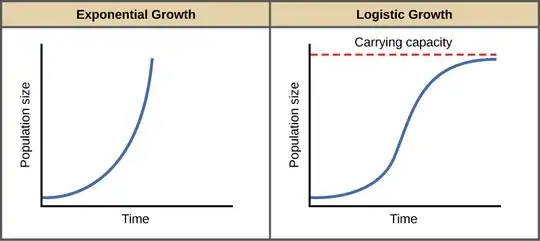
Growth curves

Image attribution: Biolibre texts. This page titled 45.3: Environmental Limits to Population Growth is shared under a CC BY 4.0 license and was authored, remixed, and/or curated by OpenStax. https://bio.libretexts.org/Bookshelves/Introductory_and_General_Biology/General_Biology_1e_(OpenStax)/8%3A_Ecology/45%3A_Population_and_Community_Ecology/45.3%3A_Environmental_Limits_to_Population_Growth

To explain the curve. At the bottom left, you have a population of bacteria/yeasts that is low in number and a lot of resources that they can use (i.e. nutrients in the flour etc that you add), as they grow in number they progress along the curve, growing fastest in the steepest part of the curve. On the top right you have lots of bacteria/yeasts but they have used up most of the resources so don't/can't replicate well and are more or less static in number with newly replicated bacteria balancing out deaths in the population.

When you add "feed" to your starter, you are essentially diluting it and adding resources, this means that you are essentially changing where on the growth curve your stater is. Commonly bacteria and yeasts replicate (i.e. double in number) at a rate somewhere between 20 min and 1-2 hours at room temperature under ideal conditions. In the lab, we commonly start with a population at the top right and dilute it to somewhere between 1/100 and 1/1000 to shift it to the bottom left.

In your case you have essentially taken your starter and essentially done two halvings, so are left with about 1/4 of the original starter. This doesn't shift the population very far from the top right of the curve. The 1-2 hour incubation doesn't affect this much as you might get few doublings in population or two in this time, dependent on temperature. I would hazard a guess that you shift it more or less to the middle, steepest part, of the growth curve and should see rapid activity in your starter - lots of bubbles etc.

This rate of feeding is not too rapid; you can dilute much much more than you are doing with no problems at all. All you need to do with higher dilutions is wait to get the starter working again. For some frame of reference, in a pure bacterial culture in bacterial growth medium, I would expect to get about 1x10⁹ (1 billion; 1,000,000,000) bacteria per millilitre (0.035 fl oz) at the top right of the growth curve, so there will be plenty of bacteria/yeasts in your starter even if you dilute it much more than you are currently doing. In fact, using less starter and therefore a longer rise time should give you more flavour in your sourdough.

As to feeding frequency, so long as you are leaving the starter out of the fridge, so as to give it time to grow well under room temperature between feedings, you should be fine. There will be some growth in the fridge, but it will be slow and you might favour (i.e select for) species that grow best under fridge temperatures, which is not ideal when you want rapid growth at room temperature.

bob1
  • 18,596
  • 34
  • 73