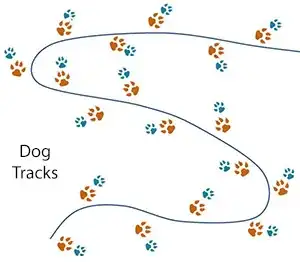
No, there's no chance to distinguish the print of a large dog from one of a wolf. However, you can still differentiate between them, if you have a whole track. Dogs walk remarkable different than their ancestors. Compared to a wolf, a dog draws a sinuous line like it was drunk.
The best way to determine if wolves are present is to find their
tracks. Wolf tracks are fairly easy to pick out, as they can be more
than twice as big as a coyote’s. They can sometimes be confused with
the tracks of large dogs, but the key is in how they walk. Whether
it’s on a packed trail, or through deep snow, a wolf wastes very
little energy while traveling. Their tracks are nearly always in a
straight line, with the left and right paws only slightly offset
(usually 6 inches or less). Compared to wolves, dogs walk like they’re
drunk. Their tracks are distinctly scattered, and often appear more
“wandering.”
Also, even on hard trails, dogs tend to drag their toes
when they walk, whereas wolves generally leave a cleaner stride. In
deep snow, distinct tracks are rarely visible. Look for a narrow trail
with in-line footprints. When a pack runs through deep snow, they
usually step in the same tracks as the wolf in front of them, which
leaves even more pronounced prints. Also, you can usually see where
their bodies have pushed a trail through the snow. The way they travel
often makes it tough to determine how many are in a pack.
From Outdoor-Life
Dog:
Wolf:
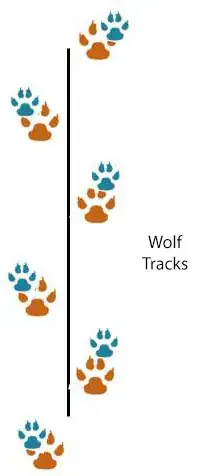
The diagrams above are exaggerated but clearly show, what one should have an eye on. Thanks to David Richerby for pointing this out.
It can be impossible to distinguish a large dog from a wolf from a
single track. Instead, if possible look for the pattern of the trail
left by the animal. Dogs’ pattern of walking reflects their domestic
lifestyle. They do not rely on stealth, and tend to walk erratically.
Their hind foot tracks seldom register within their forefoot tracks.
They may also approach strange objects directly. Wolves on the other
hand, tend to walk more directly when travelling. Their trails reflect
this, as the track of the hind foot is placed within or directly in
front of the forefoot. Wolves will also approach strange objects
cautiously, often circling widely to investigate rather than
approaching directly.
From wildlife.ca.gov


