There are two things we have to keep in mind with this subject. If the cougar populations are in decline anywhere, this would seem to mean that cougar attacks would naturally also be in decline. But if sport hunting is in fact contributing to mountain lion population declines but still not increasing public safety or reducing attacks on livestock, then other options for mountain lion management must be looked into.
Take a look at this article, which puts forth the idea that sport hunting does not reduce the likelihood of mountain lion attack:
The Mountain Lion Foundation initiated this study to test the claim that sport hunting reduces attacks on humans and predation on livestock.
Methodology
To test the claim that sport hunting reduces conflicts, we looked to California, the only western state with viable mountain lion populations that does not allow sport hunting. Mountain lions have not been sport hunted in California since 1971, first as the result of a legislative moratorium and then as the result of a 1990 citizen sponsored ballot initiative which made the ban permanent.
Consequently, for 34 years California has served as a living laboratory to study the relationship between humans and mountain lions in the absence of sport hunting. It also presents an opportunity to test whether sport hunting has been an effective conflict-reduction strategy in states where it is allowed.
Findings
With regard to mountain lion attacks on humans in the western United States and Canada from 1972 (the first year of the sport hunting ban in California) to 2005:
Nine states and one Canadian Province, which have sport hunting of mountain lions, had a higher per capita rate of attacks on humans than did California.
Two states which have sport hunting of mountain lions had a higher rate of attacks on humans per square mile of suitable mountain lion habitat than did California.
With regard to mountain lion predation on livestock, according to data from the U.S. Department of Agriculture's National Agricultural Statistics Service (NASS 1995, 1996, 2000, 2001, 2005):
Six states which have sport hunting of mountain lions reported a larger percentage of domestic sheep and lambs killed by mountain lions than did California.
Four states which have sport hunting of mountain lions reported a roughly equivalent or larger percentage of cattle and calves killed by mountain lions and bobcats than did California. [Note: NASS statistics do not distinguish between mountain lion and bobcat attacks on cattle so the actual percentage killed by mountain lions is likely smaller than presented.]
Discussion
It is noteworthy that an increase in mountain lion attacks on humans in several western states during the 1990s occurred at the same time that the number of mountain lions killed by humans was reaching record levels. According to agency records, from 1990 to 1999:
3,255 mountain lions were reported killed by sport hunters in Colorado (10 attacks on humans).
5,063 mountain lions were killed in Montana (4 attacks).
1,710 mountain lions were killed in Washington (3 attacks).
In fact, some mountain lion experts have raised the possibility that sport hunting -- rather than decreasing the likelihood of attacks -- may actually increase the risk of attacks.
For further information on this subject please take a look at this entire article: Effects of Sport Hunting Mountain Lions on Safety and Livestock. The article, charts and photos are quite interesting.
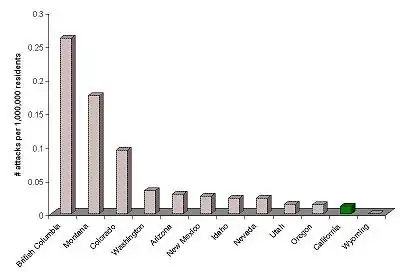
Average annual number of mountain lion attacks on humans per one million residents in the western U.S. and British Columbia, 1972-2005
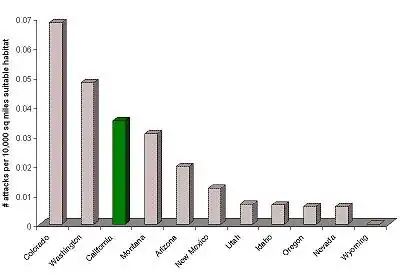
Average annual number of mountain lion attacks on humans per 10,000 square miles of suitable mountain lion habitat in the western U.S., 1972-2005
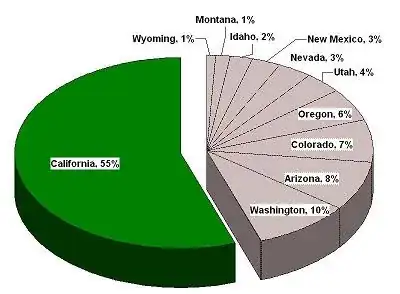
Distribution of human population in western U.S. states. Source: U.S. Census Bureau (2000)
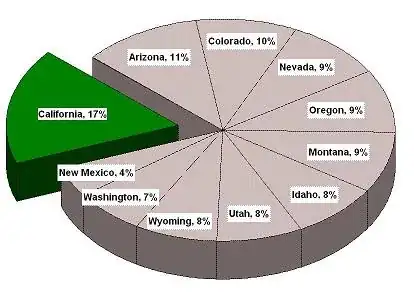
Distribution of suitable mountain lion habitat in western U.S. states. Source: Ashman et al. (1983), Edwards et al. (1995), Merrill et al. (1996), Thompson et al. (1996), Cassidy (1997), Davis et al. (1998), Redmond et al. (1998), Kagan et al. (1999), O'Neill et al. (2001), Schrupp et al. (2000), Scott et al. (2002), NMGFD (2005), CDOW (2005), Wolstenhulme (2005)


