35

I am a professional trumpet player getting ready for my first backpacking trip. I'm equipped with a plastic trumpet that I'll clip on my pack. Now I'm starting to wonder about the best way to keep my chops in shape. I plan on only playing music and etudes, maybe at the end of the day before dinner and after setting up camp. Is this sort of thing acceptable, for example within campground rules? I know how far a trumpet can carry in the wilderness (especially across bodies of water) and would not want to upset other backpackers in the area.

Further, how can I best approach practicing while on the trail? What is customary and generally accepted about artificial noise on the trail? Any thoughts or advice would be greatly appreciated.

ab2
  • 24,716
  • 9
  • 71
  • 168
Daveduder
  • 522
  • 4
  • 6

10 Answers10

107

This is just a bad idea. We don't go backpacking in order to hear other people's music. We do it in order to make contact with nature and experience a serene, quiet environment. The idea of practicing your trumpet is objectionable for the same reason that it would be objectionable for someone to bring a music player and play recorded pop music.

I really don't believe that your embouchure is so delicate that it can't go a few days without practicing. Just leave the instrument at home.

38

Depending on how much other stuff you will be carrying, a whole trumpet and case may be too heavy and/or bulky.

Just take your mouthpiece and blow through it when you feel like it, on an easy part of the trail. Maybe not your prime mouthpiece - a spare one that would be less-upsetting to loose or damage. A brass mouthpiece weighs around 75 grams (2 2/3 ounces)

Yes this will still make some noise, but it won't be the trumpetting toot that would carry for miles, and may confuse others into thinking there's an emergency or crisis, like a Disaster Whistle.

Remember, you're getting a cardio workout while walking, consider this as "cross-training" for your diaphragm.

Also walking hard is a great way to exercise your lung capacity and oxygen takeup, enabling you to blow longer passages without taking a breath.

If this seems a bit simple, part-cover the output of the mouthpiece with a finger to replicate the backpressure.

And as a hard challenge, work on circular breathing so you can continue to blow through the mouthpiece using your cheeks as a small reservoir while inflating the lungs again through your nose. Note - this is hecking-difficult and is a great skill to have.


As a cyclist, one measure of effort is "sentences" If you can enunciate a whole sentence, you're not pushing very hard. Being able to get out a "three word phrase" is an excellent training effort, and if you're only capable of single words between pants then you're working at the upper edge of effort. If you literally can't speak then that's a sprint, aka a Max-effort which can only last minutes at most.

A final technique is to "visualise" where you imagine the tune in your head, inserting the right pauses and thinking on your dynamics. This is more about rehearsing a specific piece, but lets you explore aspects of the music that you might not think about while simply reading the dots.

Criggie
  • 1,190
  • 6
  • 13
29

For one, thank you for asking and planning to be considerate. I wouldn’t wholly throw away the idea of practicing while on a backpacking trip, particularly if you’re a professional, but there are definitely ways to be considerate. I generally don’t think that people would appreciate long periods of listening to someone practicing, regardless of skill level.

In general, many places have quiet hours, though that doesn’t give you leave to be as loud as you like outside that time. Certainly restrict practice to outside quiet hours, though. And honestly, any time it’s dark, I’d presume that someone is trying to sleep, just to be safe.


Regarding ways to reduce noise, however.

For starters, have you considered also bringing some sort of practice mute? I’ve not tried one, myself, and I know that it would have some effect on your airflow, but I think that it would provide a serious dampening of sound, which would go a long way.

Aside from that, have you alternately considered bringing a set of embouchure training weights along, to minimize required practice time? That would be a way to provide exercise to the appropriate muscles without creating any disturbance.

fyrepenguin
  • 2,599
  • 1
  • 21
  • 30
24

From my perspective, it depends on where you are backbacking/camping. And it's not other humans I would be concerned about primarily.

If you are in a very remote setting where there are only very few or no other humans, then I would recommend to be careful with the noise that you make. This does not only apply to trumpeting. The wildlife in that remote area is not used to humans and their behavior, and playing the trumpet is very much like a signal announcing that humans have arrived and that everybody and everything will better get used to their invasive habits. You create stress around you and I hypothesize that you would probably induce a (transient) change of behavior of wildlife which violates the leave no trace ethics.

The fact that artificial sounds and noise have a big impact on wildlife seems to be well documented (see for example a review here). I have a little trouble to find direct evidence for the effects of trumpet sounds or music in general. This paper from 2018 investigated in how far AC/DC music and other sounds change the eating behavior of lady beetles and found a significant reduction in food uptake when music was played. Another paper from 2021 describes that the drinking behavior of bats suffered from loud Israeli pop music. No data so far for the trumpet, I am afraid.

If you backback in a touristic region in a densely populated area and/or camp on a commercial campsite with many other people then (again from my perspective) the situation is different. Playing the trumpet might annoy a few people. But is this not the standard situation for a professional instrumentalist? There probably will be a few (self-imposed) rules about practicing times etc. you follow when you practice and cannot fully isolate? Use your common sense and talk to people around you and you will be fine.


See also this related question: Etiquette of playing musical instruments on popular hikes

Snijderfrey
  • 1,732
  • 1
  • 9
  • 19
12

The Leave-no-trace tag in the question implies that you are familiar with the concept. Have you actually read the Leave No Trace principles? I'll quote from Leave No Trace Canada's 7th principle page:

Be Considerate of Others

One of the most important components of outdoor ethics is to maintain courtesy toward other visitors. It helps everyone enjoy their outdoor experience. Many people come to the outdoors to listen to nature. Excessive noise, unleashed pets and damaged surroundings take away from everyone's experience. So, keep the noise level down while traveling and if you bring a radio, tapes or CDs, use headphones so you will not disturb others. Also keep in mind that the feeling of solitude, especially in open areas, is enhanced when group size is small, contacts are infrequent and behavior is unobtrusive.

In my opinion, bringing a brass instrument on a multi-day backpacking trip where, considering this is your first experience, you are bound to camp near other people is completely inappropriate and unacceptable. I'm a pretty tolerant person when it comes to noise and I've had boisterous neighbors that stayed up late, but you can be sure if I had to endure a trumpet at a remote campsite, I can't say I wouldn't go out of my way and hike extra kilometers to find a ranger and complain.

Especially if another group was unlucky enough to have the same itinerary, meeting your playing every evening, I wouldn't be surprised if people lost their cool. That would be a horrible experience. Even a muted horn or just a mouthpiece would be grating if in close enough proximity to be heard. And some campsites can be quite tight so this isn't a far fetched proposition.

I'm sorry but a trumpet is definitely not suited for backpacking. At all. If I was guiding a group and saw a trumpet clipped on a client's pack at the trailhead, you can be sure nobody would be getting on the trail until the instrument was stashed in a car.

Gabriel
  • 5,065
  • 1
  • 15
  • 37
5

See also answers to What exactly is so wrong with playing music on trails? which are pretty much universally don't do it!


A campground in the evening has aspects of a confined space; once can of course suddenly go flashlight-hiking or drive away1 but if you've started a fire or settled in for the night, one can feel constrained to remain. Another person then injecting the last possibly imaginable sound into this situation may charm some folks and bother others.

But please consider that this situation may become a trigger for someone with PTSD and who may have gone camping with the expectation of avoiding exactly what is now being done2 to them.

This is more than just a bad idea, it is unwise and potentially harmful.

Don't do it.

Josh Lyman Relives His Traumatic Experience While Listning To Yo-Yo Ma Bach G-Major


1if you've backpacked to a campground with road access/parking 2or feels that way

uhoh
  • 981
  • 1
  • 6
  • 16
5

If you haven’t done much hiking before: Don’t underestimate how exhausting it can be.

Depending on the hike and level of fitness there is a very real chance you’ll be too exhausted to do any serious, beneficial practice.

I agree with the other answers that playing the trumpet could seriously annoy other people. However, it very much depends on time and location.

If you practice along a highway, along a loud river (assuming nobody is trying to enjoy it right besides you), on a windy day etc. it will be much less noticeable.

There are campgrounds with a more “lively” atmosphere with groups of (mostly young) people partying, Bluetooth speakers, someone playing the guitar and so on. However there are also very quiet campgrounds where even loud talking is frowned upon.

On bigger campgrounds with a reception you can ask if they have a place where noise is less of a problem. Maybe they even have a building or common room where you could practice indoors (assuming nobody else wants to use the room).

Personally I think the sound of a trumpet wouldn’t annoy me much if it’s around noon or early evening (i.e. before 9 pm), only for half an hour or so and preferably something which is nice to listen to (i.e. not the same note over and over again).

Michael
  • 694
  • 4
  • 8
3

I came in here as a musician from this question on music, so I leave the hiking relative aspect to others.

As for the need to keep the chops in shape, you could just bring your mouth piece. This does not produce that much sound as with the instrument. My brother has a plastic mouth piece lying the car, and he sometimes blows it while driving...

An even better option is to invest in a silent mute. My son plays trumpet and he has one. It has the option to plug in headphones so you can listen to what you play. Externally it stops almost all of the sound. I was quite impressed the first time I heard it.

awe
  • 139
  • 4
2

Trumpeting while backpacking?

Do not see a problem with it, but please remain considerate of others. Hunting horns have been in use for centuries and are still in use in certain countries. It is a tradition.

Nevertheless, one should be respectful of trumpeting in and around campsite, where others may get annoyed easily. Many hikers and campers appreciate the silence of the woods.

If you are backpacking in an isolated area with no one around, then I would see no problem with it at all.

Can not tell you how many times I have seen guitars playing around campfires while backpacking!

While hiking in ”Bear Country” it is encouraged to make noise while hiking, so it would be great in these areas. It could be somewhat hazardous to play while walking on rough trails.

Remember, horns and fox hunting have been a tradition for centuries.

Surely, one of the thrills of the foxhunting field is the sound of the huntsman’s horn. When huntsman and hounds are out of sight, the horn keeps the knowledgeable foxhunter informed as to the progress of the hunt.

When the huntsman doubles it in covert, that’s a good time to check your girth. When you hear the Gone Away, you watch your Field Master and anticipate that moment when the saddle tosses you standing in your stirrups and dancing to that seductive three-beat rhythm. The knowledgeable foxhunter can distinguish when the huntsman is blowing Gone to Ground to celebrate a successful conclusion, or simply collecting hounds after a loss. But have you ever tried to blow the thing yourself? Not easy!

The original hunting horn was curved, actually that from an animal, and could only sound a single note. The straight horn became the vogue around the end of the seventeenth century shortly after the fox was elevated to the front ranks of beasts of the chase. That led to what Cameron calls the “decline of Horn-music almost to the vanishing point.” The faster pace of hunting across the open undoubtedly had much to do with the diminishment of the horn music.

The twenty-five horn calls, fully detailed on the musical staves in the booklet are: On Leaving Kennels, On Moving Off to Draw, On Throwing Off (uncoupling at covertside), On Throwing Off (modern), The Seek (used in stag, hare, and otter hunting), When Drawing On (moving from one covert to another), To Call Away Hounds, When All Away (modern), The Veline (rousing the quarry or marking an otter), The Gone Away, Breaking Covert, Tally Ho, Back (followed by a crack of the thong), On a Scent, Doubling the Horn, Gone to Ground (if to dig), Call for the Terriers at an Earth, To Call Away (if not to dig), the Death of a Fox, The Mort of a Buck, The Taking of a Stag, At the Worry of an Otter, At the Killing of a Hare, The Rattle (modern), The Recheat (above), and To Notify the Field that Hounds are Going Home.

If one has a brass horn with valves, and wants to play the Fanfare of the Duc de Chartres’ Hunt at Chantilly, that’s included as a bonus! What I find missing is the horn call for the whipper-in, which has the rhythmic cadence of ‘Whip to me, whip to me.’ That must be a more modern call. -How to Blow the Hunting Horn
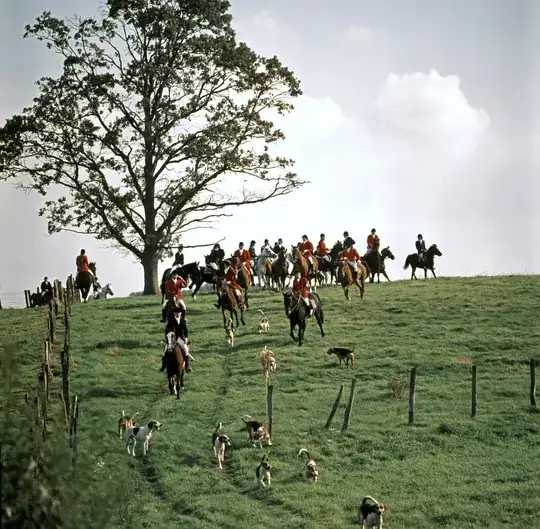
Fox hunting

Fox hunting, the chase of a fox by horsemen with a pack of hounds. The use of horns is commonplace.

The huntsman controls hounds by voice, his or her calls being known as cheers, and by a horn - a copper tube about 8 inches (20 cm) long that produces two notes of great carrying and penetrating quality.

If one prefers not to go trumpeting while backpacking, that is fine! One might consider foraging for trumpet mushrooms (Pleurotus eryngii) instead.

Ken Graham
  • 9,727
  • 2
  • 39
  • 65
-1

In Bear Country it is encouraged to make noise while hiking, so it would be OK there. It might be a bit hazardous to play while walking on rough trails. A friend played trumpet in a marching band, but the only hazards were in parades where they were behind the horses.