17

First post here -- and not an electronics expert at all. I really hope, though, that someone might give me an idea about best practice for this:

I haven't found a similar question using search.

What is the most efficient (in terms of weight/price/hassle) for 30 days of wilderness expedition? It's very dark and cold. Solar chargers are not an option. I have modest power requirements but do need to top up a 2350 mAh headtorch battery every day and a smartphone every 2nd or 3rd day. (GPS unit etc. simply run on ordinary lithium AA batteries).

What would be a solution that is:

  • Stable and robust in cold, bad weather and rough travelling.
  • Some form of redundancy would be preferable - e.g. with double units. I can probably handle losing half my power. Not all.
  • Minimizes weight and bulk
  • Minimizes hassle - It should ideally take the form of a self-contained unit or units, preferably using simple, off-the-shelf components.
  • Minimizes cost.

I had thought about simply bringing a number of 20K-50K mAh powerpacks -- loads of redundancy -- but also quite a lot of excess weight in packaging. Are there any obvious -- simple -- answers that I just don't know about?

Edit: Based on answers I ended up with a battery-based strategy. So bringing upwards of 8-10 20KmAh powe Banks + 20 Energizer lithium batteries. Will test it out over several training runs (14 day trips) during this Winter. Will report back then + after my race in Jan 2025

Henrik
  • 173
  • 1
  • 9

7 Answers7

20

I think you have already listed your options:

  • Wood-burning stoves with USB recharge ports, e.g. the one from Biolite. I have never used such a device, but according to the review it works, if slowly. Sounds like you would need to run it for quite some time to fully charge a phone though... Personally I would never want to rely on such a device, to me it seems complicated and prone to failure.
  • Power banks come in all forms and sizes - keeping both a torch and your smart phone powered for a month will call for a fair bit of battery weight though...
  • Dynamo: I have so far only seen small torches or pocked radios with manual dynamos - I don't think this is an option for charging your devices, the work you'd have to input would be considerable.
  • Batteries: this'll work for a head torch, but not the phone...

None of those seem like real options to me.

Honestly I'd rather challenge your plan. What is your plan such that it calls for 30-days of solar independent electricity? Do you really need a smart phone out in the wild?

Could you, for example, replace GPS with map and compass (which you should bring, and be competent with, anyway, as a backup) - and turn off the smart phone until actually needed?

How often do you expect to use the torch? A decent LED torch used on low-intensity settings will last you for literal days of light, so with a hand full of spare batteries you should be able to make this last a month.

Last but not least - what exactly will you need the electricity (phone/torch) for? And what are the consequences if you run out of juice mid-way? The answer to this question will have a large impact on redundancy planning and thus on how much extra you need to bring and schlep day after day.

fgysin
  • 13,424
  • 1
  • 43
  • 74
14

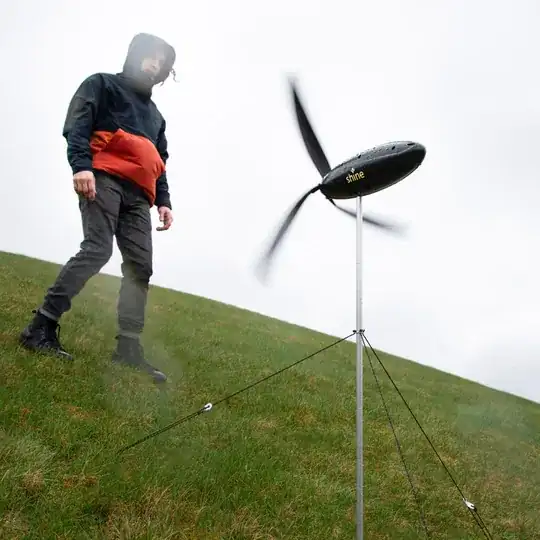
If it's going to be windy wherever you're hiking, you could potentially bring a portable wind turbine. This model called "Shine Turbine" weighs 3 lbs and seems to be reasonably small. It claims to be able to charge a phone within 70 minutes under moderately windy conditions. It also doubles as a 12,000 mAh power bank.

enter image description here

Disclaimer: I'm not affiliated with this company.

JonathanReez
  • 3,017
  • 2
  • 22
  • 47
14

First things first I'm an EE so let me rant about units ;)

I have modest power requirements but do need to top up a 2350 mAh headtorch battery every day and a smartphone every 2nd or 3rd day.

The unit of energy is the Watt*hour (Wh).

The unit of capacity of a battery is the Amp*hour (Ah) which is 1000mAh.

If a battery has a capacity of 1000mAh (1Ah) and a nominal voltage of 3.6V then it can output 1A*3.6V=3.6W for 1 hour, so its energy capacity is 3.6Wh.

If a battery has a capacity of 1000mAh (1Ah) and a nominal voltage of 12V then it can output 1A*12V=12W for 1 hour, so its energy capacity is 12Wh.

I need to bring all power and I need approx 200.000mAh/200Ah of power.

Now mAh isn't a unit of power, and since you're mixing all the units, I'm gonna bet your numbers are probably wrong too, which could be a problem ;)

I have modest power requirements but do need to top up a 2350 mAh headtorch battery every day

Assuming the usual LiIon, 3.6V*2.35Ah = about 8.5Wh/day for the light, so you'd be running at 0.85W for 10 hours, sounds legit.

and a smartphone every 2nd or 3rd day.

Is there cell coverage where you're going? Unless you intend to use it to listen to music, then alright. Say 4Ah, 14Wh every 3 days, 4.66W/day.

So that's 13 Wh/day, let's round it up to 25 just in case. 30 days, 750 Wh.

750 Wh is 62.5Ah on 12V. So I guess you forgot the voltage when going from Ah to Wh so your planned 12V battery is about 12/3.6 times too big!

GPS unit etc. simply run on ordinary lithium AA batteries).

OK.

Anyway. Let's list the specific energy of various batteries...

Non rechargeable:

  • Alkaline 65-100 Wh/kg @ 1.5V, 0°C/60°C
  • LiFeS2 300Wh @ 1.5V, 0°C/60°C
  • LiMnO2 (expensive) 280 Wh/kg ] 3.3V, -30/+60°C

Lithium rechargeable 100-265 Wh/kg, which depends mostly on packaging. For example a pouch battery does not come in a heavy metal tube like a 18650 so it is lighter, but it has no protection, so if you puncture it, it will probably explode. If that happens when you fall on it because you were carrying it inside your clothing to keep it warm, you may have a bad day.

Every inefficiency and energy loss you incur increases the amount of batteries you have to carry. So if you charge your headlamp from a powerbank, assuming 90% efficient conversion from 3.6V to 5V in the powerbank, and 70% efficient cheap linear charger, you're at 67% efficiency, so you're wasting more than 30% of your battery weight.

I like redundancy so I'd use a LED headlamp that takes an external battery. Here's an example. Since the standard battery format is 18650 this means either a headlamp with an external case where you can stuff some 18650 LiIon cells, or something like the one I linked which plugs directly into a USB power bank.

Headlamp+powerbank: you eliminate the worst inefficiency which is charging, so you go from >30% losses to 5-10% losses in the powerbank.

Headlamp+18650: optimum efficiency, since there is no conversion. You grab a fresh 18650 and stick it in.

The 18650 plan also works with LiMnO2 non-rechargeable 18650 cells which are damn expensive but still work at -30°C as a backup plan just in case.

The other issue with Lithium is temperature. At cold temperatures, they lose a lot of power output. They don't lose their stored energy though: a cold battery will appear to be discharged, but it is simply too cold to work, doesn't have any power, so the device thinks it's discharged. But the energy is still there, and if you warm it up, it will be able to work normally.

Charging a frozen lithium battery is not allowed. At these low temperatures, the ion mobility is too low so the lithium ions can't go where they should fast enough, and instead we get lithium metal dendrites forming which short the battery internally. It will then either discharge quickly (ie, it is screwed) or catch fire. In both cases, it's not reversible and the battery is kaput.

Lithium batteries with internal heaters use their stored energy to heat themselves, so that's another inefficiency.

The external headlamp battery can go to a warm place, like inside your clothes, where it will stay warm.

What I'm suggesting is either a bucket of pre-charged powerbanks, or a bucket of pre-charged 18650 batteries (in their isolated plastic cases), plus two headlamps compatible with the choice of batteries. In the 18650 case you also need a converter to get 5V but that's readily available.

In both cases you have a lot of redundancy.

It's not a problem if you store the batteries in the cold as long as you heat the one you're going to use before using it. For example you can keep it in your tent.

It would be a good idea to get a vacuum sealer (very useful for sealing food) and to seal powerbanks. This will avoid condensation inside as you warm them up. Of course you have to break the seal in order to use it, but that's after warming it up, so the worst of the condensation has been avoided.

I do not like the big lithium car battery because you won't be able to put it in your jacket, so it will be frozen. It is a single point of failure, non redundant. On the other hand being intended for automobile use it is much more likely to be designed to work in all weather conditions, compared to a powerbank which is more of a temperate indoors device.

bobflux
  • 381
  • 1
  • 6
6

I think it might just be doable with powerbanks. For example if you can afford 5 Nitecore Summit 20000 power banks (or borrow them somehow) you’ll have 337Wh of “rated energy” (i.e. at the power bank’s output) at your disposal. They’ll weigh about 1.5kg and should be enough to fully recharge your headlamp (2350mAh*3.7V=8.7Wh) about 34 times (assuming an optimistic 90% charging efficiency).

Most lithium ion batteries perform poorly below 0°C. The Nitecore Summit has an integrated heater to heat itself when it is that cold.

It would help if you could reduce your power consumption further. For example a Petzl Actic Core headlamp at its lowest setting is rated for 100h of runtime using its 4.6Wh battery. If you can find your way at that lowest setting it would make your charging situation a lot easier.

Michael
  • 694
  • 4
  • 8
5

One thing I just realized: Charging a battery with a battery (powerbank) just so you can power an LED is pretty inefficient and inconvenient. Why not connect a big battery directly to your headlamp? Some high end headlamps and bike lights already do this. For example the Lupine and Supernova lights which come with an external battery connected via cable. Lupine offers a 100Wh battery which weighs “only” 430g for their lamps. Three or four of them would probably last you the whole month. A big advantage here is also that you can keep the battery close to your body so it stays warm, instead of exposed on your head. Lupine also offers an adapter/converter to USB so you could charge your smartphone from it.

If you are handy you could build something similar with Li-Ion (or LiFePo4) pouch cells or cylindrical 18650 cells. Provided you can modify your headlamp to connect directly to a 3.7V cell via cable. For a headlamp like the Petzl Actik Core you could just make a ”fake” battery pack which presses cable ends against the contacts, then connect the cable to your 3.7V battery. The biggest challenge here would be to make it rugged and waterproof.

Michael
  • 694
  • 4
  • 8
4

Power banks seem like a terrible option for such a long trip. Don't forget that power banks often don't have the capacity they are advertised for, and that the capacity isn't transferred 1:1 to the phone/light but there is some substantial loss. Picking the first 20.000mAh random power bank from an online store, they claim to recharge an iPhone 13 (~3.000mAh) four times, at a weight of 365gr. Make that five times for your headlight, should it have a similar efficiency. So for 15 phone plus 30 light recharges you would need about 10 of these power banks, netting in more than 3,5 kg. I would suggest reducing your power usage first. Turn off the phone, use a dedicated GPS logger, turn the headlights to minimum settings.

Doug Deden
  • 105
  • 2
2

There's no question that hydrocarbon storage of energy is way lighter than battery technology, cf. Wikipedia's Energy density; in energy storage and fuels.

Carbohydrates + dynamo

So I wonder why, with modern rare earth magnetic materials you would say that:

...and dynamos are probably not feasible.

Get a high conversion efficiency hand (or foot) cranked generator. Bring and eat extra carbs, train accordingly ahead of time to build the appropriate muscles to make enough power each day.

Walmart has them so I would expect there are better ones as well. This is one candidate.

Fuel Cells (hydrocarbon, not hydrogen)

Yes this is an exotic solution, but maybe you can bargain for a sponsorship unless it's against the rules.

Someday we'll be charging our laptops with lighter fluid, but there might be something available today.

While hydrogen requires heavy tanks and is tricky to handle (it leaks due to tiny molecules with high mobility) light hydrocarbons like methanol or possibly propate/butane may be available.

Here is an example of the technology, but I think this particular model is not suitable for your application.

The Honey Badger 50™ reformed methanol fuel cell is the industry’s newest ultra compact and highly portable fuel cell. The Honey Badger 50™ is designed for rugged, off-grid uses.

The Honey Badger 50™ is ideal for a wide variety of higher power electronic applications, including radio and satellite communication gear, remote and mobile surveillance systems, and laptop computer and battery charging.


A plot of selected energy densities (excluding oxidizers). Date: 22 December 2008

A plot of selected energy densities (excluding oxidizers). Date: 22 December 2008 Source

uhoh
  • 981
  • 1
  • 6
  • 16