16

I went camping last trip and my nice inflated pad... deflated. I always carry a patch kit but I discovered another issue: I couldn't find the leak. The leak was small. It took quite a while of me lying on it for the pad to deflate. I as not able to locate the leak in order to patch it.

How do you locate a small leak in an inflatable sleeping pad?

Mr.Wizard
  • 9,546
  • 1
  • 40
  • 77
Russell Steen
  • 32,221
  • 23
  • 135
  • 275

3 Answers3

14

Sometimes you don't have a place to submerge your pad to find leaks, or it's just too cumbersome to do so. Here is a method for leak-finding that can be done at home or in the field:
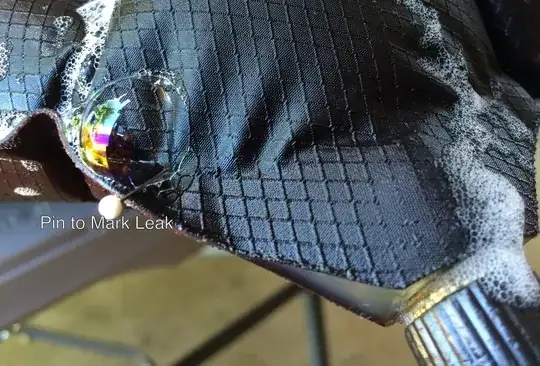
Photo of soapy pad with pin in leak (Note the location: in a crease that is repeatedly stressed, being by the valve. Also note the difference between bubbles from suds and the bubble from the leak.)

  1. Fill a squirt bottle, spray bottle, hydration bladder (something with a nozzle to control the flow) with water near to the top.
  2. Add several drops of liquid soap (dish detergent works best).
  3. Wet your fully inflated sleeping pad with the mixture.
  4. Look for bubbles forming to isolate the leak(s).
  5. Carefully mark the location of the leak with a needle/pin (you've got to fix the leak anyway) as you will lose it as soon as you rinse the soapy water away. You may try a grease pencil or china marker but not much else will write on a soapy wet surface. (Note that a grease pencil or china marker can leave residue which can impede adhesion of the patch. If you use one of those, make your reference marks outside of the range of where the patch will go. A pin or needle is best.)
  6. Rinse the area to be patched of the soapy water.
  7. Let the pad dry and follow your procedure for repairing the leak!

I've had to use this method several times and it always works. Be systematic about it so you can keep track of what you've checked. Usually leaks occur on the bottom of your pad, or they could be at a failing seam, so target those areas first. Also you might have to refill the bottle once or twice before you find the leak, depending on the size of the pad and just how lucky you get. If you're mix isn't sudsy enough, add more soap.

montane
  • 5,625
  • 7
  • 44
  • 68
12

Take a bath.

Fill the bath tub with water and the pad with air, and put the pad underwater (if it's too big to all go under at once, check section by section). You should see bubbles coming out of the leak.

Kevin
  • 5,348
  • 4
  • 34
  • 50
2

In the past I have filled the sleeping pad with water to find leaks.

  1. Fill pad with water
  2. Leave it outside so that the outside of the pad dries off (you may need to flip it over at some point, to dry both sides) There will be a persistent wet spot near the leak, where the pad won't ever dry off. (You can slightly pressurize the pad as normal if necessary, but usually filling it with water is enough.)
  3. Once the leak is found I mark it with a sharpie
  4. Empty the water out
  5. Dry the outside of the pad
  6. Repair the leak (Seamgrip works very well in my experience)
  7. Wait for the repair to cure, reinflate the pad, hang it so that the remaining water collects near the deflate hole, then drain that water,
  8. Repeat that step a few times until there isn't any water left.

This works very well to find the leaks, but it is a lot of work, and the pad can get mildew inside if you're not fastidious about drying the inside. To be honest the soapy water method sounds better to me, because of how much work this method is, but I'm posting this anyways because of how reliable I've found it. It has worked for me every time, and I've fixed a bunch of holes in our pads with this method. It can also be done while camping, if you have access to enough water.

nmr
  • 121
  • 2