Which is better to use during a night trek - a flashlight or a headlamp? Which do you prefer? Would be great if recommend the one you use and tell me what made you buy it.
Asked
Active
Viewed 6,321 times


11 Answers
18
For night trekking, I use a headlamp. Couple of reasons:
- Keeps your hands free. (Useful when you are walking up steep slopes)
- No worry of dropping them flashlight (Had happened to me once where my flashlight rolled down the hill)
Advantages of a flashlight over a headlamp:
- More powerful and directional. (No need to strain your head in weird angles to get the light to shine at something)
- Headlamps are not meant for long distance lighting due to the wider and less focused light. Flashlights excel at this.
My choice is a headlamp while night trekking and a flashlight in my backpack in case my headlamp fails me for some reason. I use a petzl LED headlamp and a geonaute LED flashlight.
PS: You can use a trekking pole with a flashlight holder. But if you aren't someone who uses a trekking pole(I do not use most of the times), then you have to hold the flashlight with your hands.

Ricketyship
- 7,855
- 3
- 34
- 69
9
I tried out both options when I started night hiking and can share the following observations:
- Flashlights are generally more powerful and directional - you can point a beam of light much further away; useful if you are trying to see further around you, for example to determine where each fork in the trail leads.
- Headlamps are less powerful for the same price (though there are some very bright ones) and are primarily useful for seeing the ground in front of you, so you do not step into a ditch or something.
- Flashlights have a narrow beam, whereas headlamps tend to have a wider one. Using a flashlight to see the ground close to you is not as comfortable, as there is one very bright spot and then darkness; a headlamp spreads the light around more.
These days I use trekking poles, which means my hands are full and thus the headlamp becomes the obvious choice. I still carry a flashlight but find that I almost never need to use it.
I use a high-power LED headlamp (with lights I find that less LEDs means it is of higher quality).

Sander
- 594
- 4
- 11
7
I have used both for night hiking, and I like a headlamp way better. The main reasons are that it leaves the hands free, and the light is aiming roughly in the direction I'm looking. I made my own headlamp with 4 white LEDs in series:
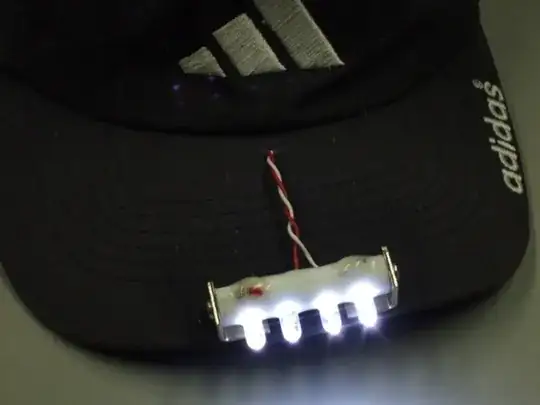
This seems to be a good brightness for hiking and seeing the ground in front of you. Having it built into a hat is also nicer than a separate deliberate headlamp. I used to have one of those (actually I still have it, just haven't used it since I made this headlamp), and it always felt somewhat uncomfortable on my head and never worked right with a hat and is fiddly with a wool cap.
One drawback of a headlamp is that since the light is coming from close to the same direction you are looking from, you don't get much help from shadows to get 3D cues. Everything looks "flat".
If you are deliberatly going night hiking, always take at least two independent means of making light, and at least one extra set of consumables for each. For example, you can use a headlamp as your primary light, but bring a hand-held flashlight to augment the headlamp in particular situations and as a backup. For example, when getting to a trail intersection, it can be useful to shine a more focused light around a bit. Bring a flashlight that you are willing to hike out with in case the primary light fails for whatever reason.

Olin Lathrop
- 21,539
- 2
- 68
- 117
4
In my personal experience, a headlamp is much better. It doesn't have the directional capabilities of a traditional flashlight, but it leaves your hands free for other tools. During an emergency hike/climb down a mountain in sub-zero temperatures I needed to use my hands to hold on to trekking polls and other hand-holds and the headlamp saved my life, I probably wouldn't have been able to get down without one.

Blackbear
- 1,902
- 3
- 18
- 26
3
I'm going to have to disagree with others here about headlamps. Although they can come in handy in certain situations, I don't really like them for hiking. For me, a handheld flashlight is best for the following reasons:
GLARE! This is probably my least favorite thing about headlamps. When you have your light source so close to your eyes, any mist or dust that is in the air is going to cause rather intense glare. Especially if you use a brighter headlamp. With a flashlight, this isn't a problem since you move the beam away from your eyes.
Generally longer running. With a headlamp, you don't want heavy batteries. This is less of a problem with handheld flashlights. For instance, multiple AA batteries, multiple 18650 batteries, or even single 26650 batteries can considerably increase runtime. But they would likely be too heavy to comfortably strap to your head.
Higher output when you need it. Since headlamps use wimpier power sources (for reasons listed above), output generally can't be as high as flashlights. Also, because weight of the lamp itself can be an issue, brighter LED headlamps often need to quickly step down brightness in order to prevent overheating.
Better tint choices. Let's face it. Some of us just HATE that 'angry blue' output typical of LED flashlights and headlamps. But the reality is that, although these nasty 'cool white' tints are extremely common, LEDs are available that can actually put out nicer, warmer tints with better color rendition. A warmer tint can make a night hike just THAT much more pleasant. But you are more likely to find these better LEDs used on flashlights than headlamps.
Easier to change brightness modes. The controls are at your fingertips with flashlights. Not so with headlamps.
Can instantly be pointed where you want it. Once again. This is obvious. Simply point a flashlight where you want it to go. But a headlamp often requires fiddling around with it. This can be a particular problem when you look another person in the face and blind them.
Better when you're hot and sweaty. Do you REALLY want something strapped to your forehead when it's warm out and your forehead is pouring sweat?

Matt
- 31
- 1
1
I've tried hiking with a flashlight, no thanks, it's always my headlamp. The headlamp leaves my hands free for my poles. It's nowhere near as bright as a flashlight but it's bright enough to hike with. My flashlight normally stays in my pack--it's come out once when we weren't sure of the path (we knew where we were going but the trail disappeared on rocks), but for examining the terrain while standing still but that was it.
As for some of the negatives mentioned in other answers:
Glare--if there were a lot of stuff in the air that could be an issue. However, that's a very rare occurrence here and I've never had a problem at night.
Hot and sweaty--I can definitely see that as an issue, but I generally avoid hiking in those conditions anyway.

Loren Pechtel
- 2,342
- 14
- 20
1
There have been some good answers already. Just adding my experience as someone living in Indonesia. If you trek in a jungle, the amount of bugs that are attracted to your headlamp can get WILDLY uncomfortable. Take that into account when deciding. That said, especially in that environment you often need to use your hands in case it gets slippery, so you may not really have a choice either.

Sebastiaan van den Broek
- 2,300
- 17
- 15
1
A flashlight is in my experience much better for traveling at night. This because:
- It throws out a more powerful beam than almost any headlamp - The problem with a headlamp is that any bright enough beam to be useful on most trails is going to affect your vision (especially if you wear glasses)
- Most headlamps are only comfortable to wear for relatively short periods of time. You can always change hands with a flashlight. If your headlamp is too snug, you'll soon notice that it is an annoyance to wear.
- A flashlight is always useful as a bludgeon - Not knowing where you might be hiking and who or what you might encounter, having a solid object in your hands might come in very "handy" if things go south.
- Most flashlights have a flat base meaning that they can be set on end and used as an impromptu "lantern." - Obviously a headlamp really can't be used for this.
- A flashlight can used as signaling device in case of an emergency - While a headlamp could be in some situations, its inferior light output limits its effectiveness in this mode.
WHile I would always take two flashlights and a headlamp, I would prefer the flashlights as my "go to" lighting devices on a night trek.

Mistah Mix
- 127
- 2
0
Whichever you prefer: you need a backup in case it breaks!
So you might as well take 1 each and have both available in any situation where one of them is clearly superior.

Michael Borgwardt
- 5,163
- 1
- 25
- 32
0
Hiking is best done at any time of day for an outdoor enthusiast. However, while most night walks are scheduled, unexpected delays on daytime trips may compel you to hike in the dark as you return. So, when roaming, you should always be prepared for any circumstance and carry a decent light in your bag just in case. However, which choice should you select between a headlamp and a flashlight to observe trails in the dark?
Flashlights are great for overall power and battery life since their size and weight are not restricted to what is suitable to wear on your head. While headlamps may have less punch and battery life than big torches, contemporary headlamps with cutting-edge LEDs and batteries are coming extremely close in terms of power and battery life. Furthermore, they improve flexibility by freeing your hands to focus on climbing, crawling, hauling gear, and other tasks.
Headlamps are an essential tool to have with you when trekking at night; one obvious benefit they have over flashlights is that they allow you to keep your hands free. They are incredibly light, weighing only a few ounces, so you can comfortably walk around with them on your head.
At night, trails can be difficult to navigate. Aside from resembling an undiscovered maze, these trails typically contain pebbles, tree roots, twigs, and animals. Any of these barriers can be dangerous, and having your hands free allows you to catch yourself, move obstructions, sprint, or fend off an angry rabbit on the route. Okay, don't worry about the bunnies, but you get the idea. A light offers numerous benefits that will make nighttime hiking both enjoyable and safe.

cristy
- 61
- 3
0
Short answer: Headlamp sucks at real hiking.
Long answer: Headlamp and Flashlight has different use. As some previous comments already stated, you see NO SHADOWS with a headlamp alone. At typical brightness of LED headlight, it very difficult to tell protrusions/pits apart form flat area WITHOUT SHADOWS. Result will be constant tripping/falling while you hike. VERY ANNOYING. Headlamps are handy when you need both hand for work, e.g. cooking, making a tent, map-reading etc.
Conclusion: Get both, but use flashlight when you are on the walk. P.S. Use a low intensity floodlight normal hike, use a high power spotlight for pathfinding/beaming at distant.

dillee1
- 25
- 1