13

I just saw a documentary where they investigated lakes inside of glaciers. They rapelled in big crevasses and even dived in those sometimes huge water reservoirs.

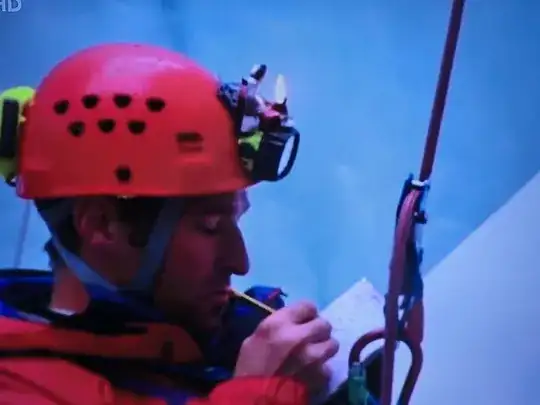
The scientist had a regular looking headlamp but on top of it there seemed to be an open flame. What could be the purpose of this tool and how does it work?

Made a picture of that headlamp:

enter image description here

Wills
  • 12,229
  • 5
  • 54
  • 115

2 Answers2

18

I would guess it's a carbide lamp as it was in former times used by mining workers and is still used in speleology (caving) sometimes.

The basic working principle is a box with carbide and a water reservoir from which water slowly drips onto the carbide. Carbide and water chemically react and form acetylene gas which is guided through a hose to a small nozzle where it is burned. The flame is in front of a metallic mirror to concentrate the light.

So why is this (still) used? The advantage of this setup are

  • Less problems with cold temperatures: Batteries tend to provide significantly less power when they get cold. As in caves and glaciers the temperatures are at best something like 10°C, this can be some serious problem if one has to work there for longer.
  • Better energy density (energy per weight ratio): Compared to batteries carbide provides more energy per weight and in many glacier or caving spots water – the second ingredient – can be obtained nearly everywhere, so one has to carry only the amount of carbide needed.
  • No electricity problems: there are no electric circuits that could be short cut when water enters the lamp system.

Possibly they did wear those lamps just for the documentary to give it some nostalgic touch, but there are situations where such lamps are at least not worse than battery powered ones.

Benedikt Bauer
  • 7,572
  • 3
  • 34
  • 58
4

What you're looking at is a carbide lamp, and it looks to be a Petzl Aceto. What you can't see in this photo is the generator, which is a round canister with two parts. The upper part contains water, which drips into the lower part containing small lumps of calcium carbide. The reaction releases acetylene gas, which travels via a tube to the actual lamp.

Compared with electric lamps they have a few advantages:

  • Much more robust and resistant to water ingress (water is no harm at all)
  • No need to recharge batteries every day (it's easy to carry enough carbide for a week-long trip if necessary)
  • Continuously-variable brightness (and peak brightness greater than halogen bulbs)
  • Performs better in the cold
  • Actually generates warmth (both the generator and the flame) - useful in emergency situations

And a few disadvantages:

  • A tendency to extinguish in waterfalls
  • Leaves soot marks when waiting around
  • Spent carbide needs disposing of properly

Over the last couple of decades, electric lamps have improved greatly with new technologies (Li-ion batteries and LEDs) and better build quality that the advantages aren't as great as they used to be. And some cave systems have restrictions prohibiting the use of carbide (generally for conservation reasons, due to a history of indiscriminate dumping of spent rocks). But carbide still comes into its own on long expeditions, and as the photo shows, it's common to have both carbide and electric on the helmet so that each can be used where it's the best tool for the conditions.
Toby Speight
  • 4,926
  • 23
  • 44