Area of Parallelogram/Parallelogram
Theorem
Let $ABCD$ be a parallelogram whose adjacent sides are of length $a$ and $b$ enclosing an angle $\theta$.
The area of $ABCD$ equals the product of one of its bases and the associated altitude:
| \(\ds \map \Area {ABCD}\) | \(=\) | \(\ds b h\) | ||||||||||||
| \(\ds \) | \(=\) | \(\ds a b \sin \theta\) |
where:
- $b$ is the side of $ABCD$ which has been chosen to be the base
- $h$ is the altitude of $ABCD$ from $b$.
Proof
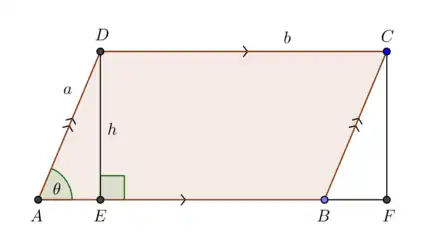
Let $ABCD$ be the parallelogram whose area is being sought.
Let $F$ be the foot of the altitude from $C$
Also construct the point $E$ such that $DE$ is the altitude from $D$ (see figure above).
Extend $AB$ to $F$.
Then:
| \(\ds AD\) | \(\cong\) | \(\ds BC\) | ||||||||||||
| \(\ds \angle AED\) | \(\cong\) | \(\ds \angle BFC\) | ||||||||||||
| \(\ds DE\) | \(\cong\) | \(\ds CF\) |
Thus:
- $\triangle AED \cong \triangle BFC \implies \map \Area {AED} = \map \Area {BFC}$
So:
| \(\ds \map \Area {ABCD}\) | \(=\) | \(\ds EF \cdot FC\) | ||||||||||||
| \(\ds \) | \(=\) | \(\ds AB \cdot DE\) | ||||||||||||
| \(\ds \) | \(=\) | \(\ds b h\) | ||||||||||||
| \(\ds \) | \(=\) | \(\ds a b \sin \theta\) | Definition of Sine of Angle: $h = a \sin \theta$ |
$\blacksquare$
Sources
- 1968: Murray R. Spiegel: Mathematical Handbook of Formulas and Tables ... (previous) ... (next): $\S 4$: Geometric Formulas: Parallelogram of Altitude $h$ and Base $b$: $4.3$
- 2009: Murray R. Spiegel, Seymour Lipschutz and John Liu: Mathematical Handbook of Formulas and Tables (3rd ed.) ... (previous) ... (next): $\S 7$: Geometric Formulas: Parallelogram of Altitude $h$ and Base $b$: $7.3.$
- 2014: Christopher Clapham and James Nicholson: The Concise Oxford Dictionary of Mathematics (5th ed.) ... (previous) ... (next): parallelogram
- 2014: Christopher Clapham and James Nicholson: The Concise Oxford Dictionary of Mathematics (5th ed.) ... (previous) ... (next): Appendix $1$: Areas and volumes
- 2021: Richard Earl and James Nicholson: The Concise Oxford Dictionary of Mathematics (6th ed.) ... (previous) ... (next): Appendix $1$: Areas and volumes