Perimeter of Rectangle
Theorem
Let $ABCD$ be a rectangle whose side lengths are $a$ and $b$.
The perimeter of $ABCD$ is $2 a + 2 b$.
Proof 1
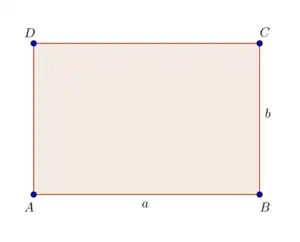
From Rectangle is Parallelogram, $ABCD$ is a parallelogram.
By Opposite Sides and Angles of Parallelogram are Equal it follows that:
- $AB = CD$
- $BC = AD$
The perimeter of $ABCD$ is $AB + BC + CD + AD$.
But $AB = CD = a$ and $BC = AD = b$.
Hence the result.
$\blacksquare$
Proof 2
From Rectangle is Parallelogram, $ABCD$ is a parallelogram.
The result then follows from a direct application of Perimeter of Parallelogram.
$\blacksquare$
Sources
- 1968: Murray R. Spiegel: Mathematical Handbook of Formulas and Tables ... (previous) ... (next): $\S 4$: Geometric Formulas: Rectangle of Length $b$ and Width $a$: $4.2$
- 2009: Murray R. Spiegel, Seymour Lipschutz and John Liu: Mathematical Handbook of Formulas and Tables (3rd ed.) ... (previous) ... (next): $\S 7$: Geometric Formulas: Rectangle of Length $b$ and Width $a$: $7.2.$
- 2014: Christopher Clapham and James Nicholson: The Concise Oxford Dictionary of Mathematics (5th ed.) ... (previous) ... (next): perimeter
- 2021: Richard Earl and James Nicholson: The Concise Oxford Dictionary of Mathematics (6th ed.) ... (previous) ... (next): perimeter